

درباره این کتاب
عنوان اصلی:
The Classic of Changes: A New Translation of the I Ching as Interpreted by Wang Bi(226–249 CE)
کلاسیک تغییرات: ترجمهای تازه از ای جینگ با تفسیر وانگ بی
وانگ بی (۲۲۶–۲۴۹ م.) با وجود عمر کوتاه خود (حدود ۲۳-۲۴ سال)، یکی از اثرگذارترین متفکران تاریخ چین به شمار میآید. او از برجستهترین نمایندگان جریان فکری شوانشوئه («حکمت رازآمیز» یا «فلسفهی ژرف») بود؛ جریانی که در پی بازخوانی میراث کنفوسیوسی و دائویی در قالبی فلسفی و متافیزیکی برآمد. شرحهای او بر دائو ده جینگ و ای جینگ از تأثیرگذارترین آثار تفسیری در سراسر سنت فکری چین به شمار میروند و برای نزدیک به هزار سال تنها مرجع معتبر مطالعهی این دو متن بودهاند.
در مرکز اندیشهی وانگ بی مفهوم وو (無، نیستی، بیتعینی یا غیب مطلق) قرار دارد؛ اصلی که از نظر او سرچشمه و بنیاد همهی پدیدههای متعین است. او استدلال میکند که کثرت موجودات و دگرگونیهای جهان تنها بر پایهی امری نامتعین و فراتر از صورتها (بسیط محض، صمد، احد، برهمن) امکان ظهور مییابند. از این رو، ششخطیها و نمادهای ای جینگ در نظر او صرفاً ابزار پیشگویی نیستند، بلکه تجلیات گوناگون یک اصل بنیادین و یگانهاند که در پس همهی تحولات جهان حضور دارد.
تفسیر وانگ بی نقطهی عطفی در تاریخ ای جینگ به شمار میرود، زیرا پس از سدهها توجه را از کاربردهای پیشگویانهی کتاب به سوی معانی حقیقی و ساختار فلسفی و متافیزیکی آن معطوف کرد. نفوذ این خوانش چنان گسترده بود که نهتنها بر سنتهای بعدی کنفوسیوسی و دائویی، بلکه بر شکلگیری زبان فلسفی بودیسم در چین نیز تأثیر عمیقی گذاشت. از این رو، شرح او بر ای جینگ را میتوان یکی از مهمترین و ماندگارترین تفسیرهای فلسفی این اثر در سراسر تاریخ شرق آسیا دانست.
شش خطی 53
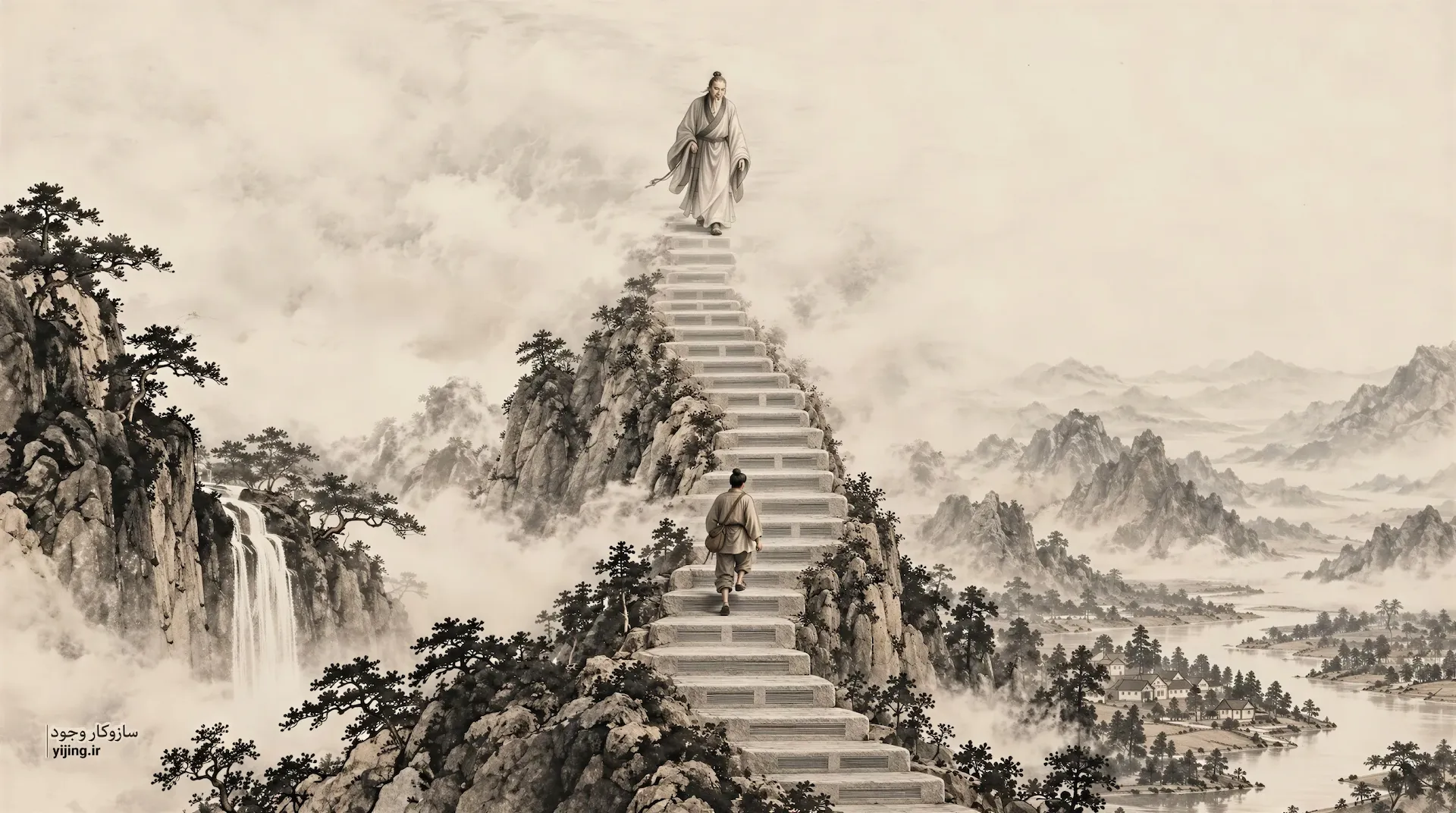
رشد تدریجی، پیشرفت گامبهگام (Jiàn)
اسامی و مفاهیم دیگر: همکاری درست، برداشتن گامهای لازم برای ازدواج، رشد آهسته و پیوسته، گامهای استوار، نماد پیشرفت تدریجی، نفوذ، رشد، قدم به قدم
Sequence:
Things cannot remain in a state of Restraint forever. This is why Gen [Restraint, Hexagram 52] is followed by Jian [Gradual Advance]. Jian here means “to advance.”
THE HEXAGRAMS IN IRREGULAR ORDER
Jian [Gradual Advance] signifies a woman who would marry but waits for the man to act.
سنجش:
تفسیر کنفوسیوس
“When a maiden marries, there is good fortune,” which means that when one advances, he obtains a position, or when one sets forth, he has meritorious achievement. If one advances with rectitude, he can thereby rectify the state. This is the position of one who achieves centrality through hardness and strength. { W.B: It is because one advances gradually that he obtains his position.}
If there is restraint and compliance, one's actions will not founder.2
تصویر:
خط اول:
خط دوم:
خط سوم:
خط چهارم:
خط پنجم:
خط ششم:
1. This and all subsequent text set off in this manner is commentary by Wang Bi.
2. Kong Yingda comments: "Restraint means that one does not engage in precipitous action, and compliance means that one is able to act with modesty. As one advances as one should in this way, none will be opposed to him, thus such a one's actions will gradually make progress and never founder." See Zhouyi zhengyi, 5: 29b.
3. The lower trigram is Gen (Mountain), and the upper trigram is Sun (Compliance), which is associated with Wood and hence Tree.
4. Kong Yingda comments:
When trees grow atop a mountain, they achieve their lofty position because of the mountain, and it is not because they suddenly spring up from below. Thus the image expresses the concept of Gradual Advance…. Improvement is always a matter of the civilized and virtuous [wende] behaving with modesty and humility and making advances gradually, for if one precipitously were to employ intimidation and punishments instead, others would not obey.
See Zhouyi zhengyi, 5: 29b.
5. See section eight of the Commentary on the Appended Phrases, Part Two.
6. The lower trigram Gen (Restraint) is associated with the Youngest Son. See section ten of Explaining the Trigrams. Lou Yulie, considering the remainder of Wang Bi's comment, glosses "youngest son" (xiaozi) as "petty man" (xiaoren). See Wang Bi ji jiaoshi, 2: 486 n. 3. Both Cheng Yi and Zhu Xi, on the other hand, say that it is the "youngest son" himself who is in danger because of the slander of others but that he can avoid blame by holding to his moral principles. Their reading of First Yin would seem to be: "The wild goose gradually approaches the shore. The youngest son is in danger, for there are words, but he shall be without blame." See Zhouyi zhezhong, 7: 22b–23a.
7. "Not before had he had his fill" translates busu bao ye. This follows Kong Yingda's commentary, in which he glosses su as gu (in the past, before). See Zhouyi zhengyi, 5: 30a. However, Cheng Yi glosses su as kong (in vain, to no purpose): "What the text means by 'one drinks and eats with delight' is that this one has achieved the goal of his moral will and now enjoys peace and harmony; it does not mean that he does nothing more than enjoy his fill of drink and food to no purpose [i.e., as an end in itself]." Likewise, Zhu Xi glosses su as tu (merely, pointless) and seems to interpret the text in the same way as Cheng. See Zhouyi zhezhong, 12: 51a–51b.
8. "Guard against harassment" translates yu kou. Kong Yingda comments: "Here Third Yang bonds with [a line from] a different trigram. It fears that there will be strife caused by enemies who will try to come between them. However, Third Yang enters into this union with such compliance that it provides for their mutual security, and so no other can come between them." See Zhouyi zhengyi, 5: 30b. Cheng Yi interprets this differently: "What is fitting for one at Third Yang is for him to ward off bandits [yu kou]. To reach a certain point in an unprincipled manner is banditry. To maintain one's rectitude and so distance oneself from licentiousness is what is meant here by 'ward off bandits.' If one is unable to ward off bandits in this way, one will cause oneself to go astray and so have misfortune"; i.e., if "the husband sets forth," there will be misfortune, so one at Third Yang ought not set forth and should stay put and keep guard over his own rectitude. See Zhouyi zhezhong, 7: 34a.
9. Kong Yingda comments: "Because Fourth Yin rides atop a yang line [Third Yang], one should take aversion to its contrariness. However, Third Yang bonds and takes up with Fourth Yin in such a way that this union provides for mutual security. This is why the text says: 'So this one is compliant and provides for the common defense.' " See Zhouyi zhengyi, 5: 30b.
Cheng Yi has a different interpretation:
What it is fitting to do is to ward off bandits. This means that one should use the Dao of compliance and so provide mutual defense. When the noble man joins with the petty man, he preserves his rectitude by keeping guard over himself, but how can this be nothing more than just keeping himself whole? He also enables the petty man to avoid falling into unprincipled behavior. Thus he uses the Dao of compliance and so provides mutual defense. One wards off evil that might befall them, and this is why the text says "ward off bandits."
Cheng's reading of the text here would seem to be: "To ward off bandits means that one should provide for mutual defense by being compliant." See Zhouyi zhezhong, 12:52a.
10. "Proper perch" translates qijue. A jue is a rafter or a level, stable branch on a tree. Both Cheng Yi and Zhu Xi take the opposite view and say that a tree is not a proper perch for a wild goose and that such a place is dangerous for it. But if it were to obtain a level branch (jue) for a perch, it might be safe after all. See Zhouyi zhezhong, 7: 34b–35a.
11. Kong Yingda comments: "Although Fourth Yin rides atop Third Yang, as it embodies compliance, it subordinates itself to the one below, and although Third Yang is ridden upon, as it obeys the one above, it provides mutual protection. This is how Fourth Yin obtains a safe perch for itself." See Zhouyi zhengyi, 5: 31a. Cheng Yi interprets this differently:
A jue [level branch] is a place of safety and stability. The Dao by which one may seek security consists of nothing but obedience and compliance. If one's moral actions are centered on compliance and rectitude and if one positions oneself in such a way that he remains lowly and compliant, what place would ever be unsafe? If one at Fourth Yin exercises compliance out of a sense of obedience and rectitude, he will obtain a level branch.
See Zhouyi zhezhong, 12: 52b.
12. "The Dao will be saved" translates dao ji, a double entendre that also can mean "the road will be delivered"—i.e., the road between Fifth Yang and Second Yin will be cleared of obstacles.
13. "Model" translates yi, which Kong Yingda glosses as yibiao. Cheng Yi glosses it similarly as yifa, but Zhu Xi glosses it as yishi (ceremonial dress decoration). Both Cheng and Zhu read lu (highland) as kui: great thoroughfare, i.e., the sky, where birds fly. They also both take Top Yang to refer to the transcendent individual who has escaped the bounds of office and position. Cheng, like Wang Bi and Kong Yingda, says that such purity can serve as a model, but Zhu says: "Top Yang has reached a height far beyond the positions of the human world. Nevertheless, its feathers can be used as ceremonial dress decoration. This is the image of one who, though extremely aloof, is still not without his uses." See Zhouyi zhezhong, 7: 36a–36b.
هر یک از این شش خط به مسیر توسعهی تدریجی مربوط میشود. با این حال، خط اول بسیار ضعیف و خط سوم بسیار قوی است؛ از این رو، هیچ یک مسیر مطلوبی برای پیشرفت به شمار نمیآیند. چهار خط دیگر، همگی نشاندهندهی پیشرفت تدریجی هستند که به ترتیبی مناسب به دست میآید. در این مسیر، گاه تسلیم و گاه استوار، هر مرحله مطابق با زمان و شرایط خود انجام میشود و در نهایت، تمامیت و عملکرد بزرگ این توسعهی تدریجی آشکار میگردد. (ییمینگ)
گفتارهای شش خطی 53