
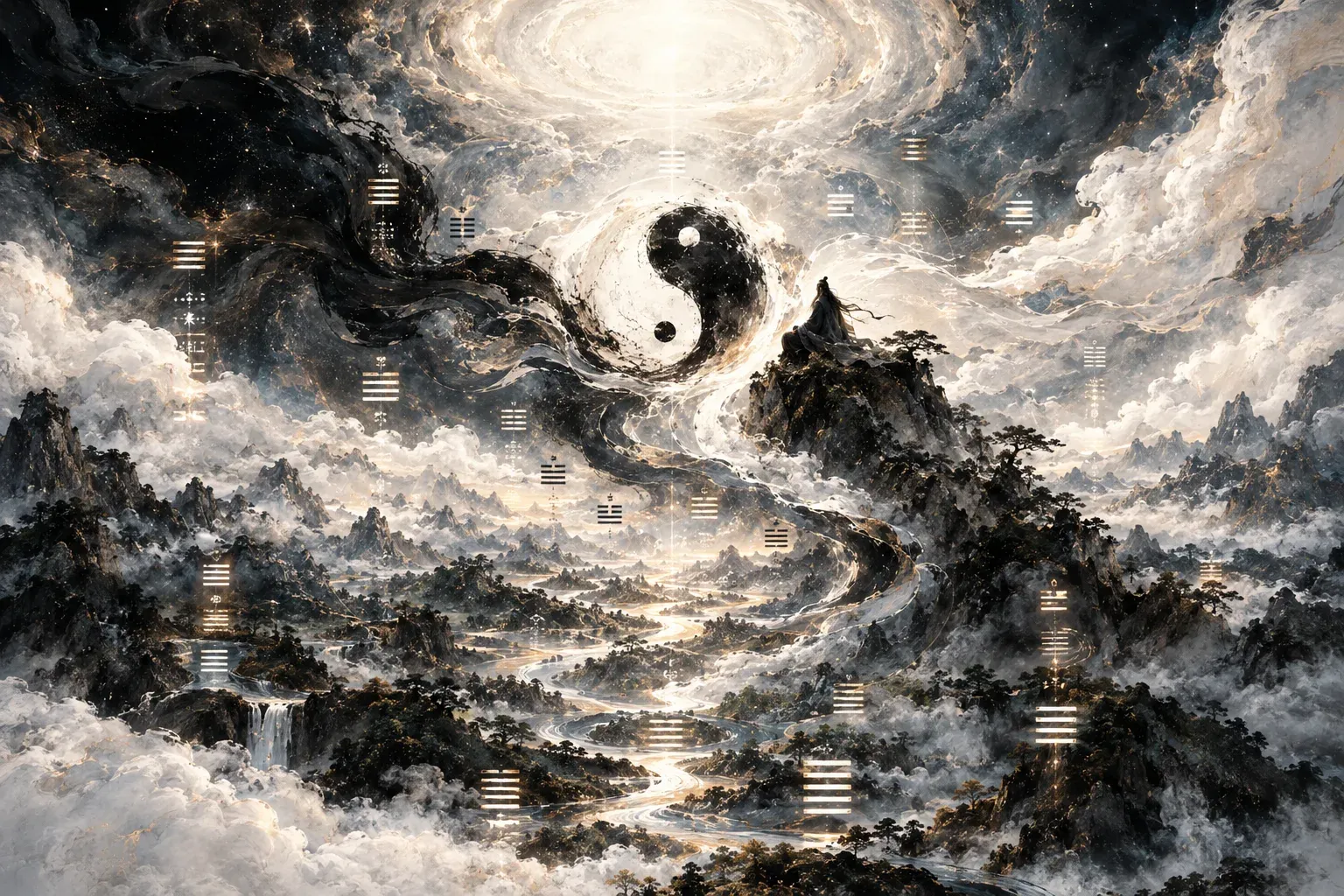

Settlement means the mutual completion of yin and yang: Being settled is the culmination of the mutual completion of yin and yang. As to the qualities of the hexagram, above is water , a pitfall, and below is fire , luminous. Using danger to nourish illumination, using illumination to guard against danger, understanding is born from difficulty and difficulty is passed through by understanding: As illumination and danger, understanding and difficulty, offset each other, this is called settled.
This hexagram represents forestalling danger, foreseeing perils, and stably completing the basis of the elixir; it follows on the preceding hexagram faithfulness in the center. Faithfulness in the center involves joyful, harmonious praxis leading to deep attainment of self-realization, so that any incompleteness of yin and yang can be settled. As long as there is incompleteness, one should seek completion; once complete, one should preserve completeness. Preserving completeness is the work of stabilizing and completing the basis of the elixir. Stabilizing the basis of the elixir is a matter of using illumination to guard against danger, holding off danger and nurturing illumination. Nurturing illumination means concealing illumination within, having knowledge but not using it, having ability but not employing it, clarifying the quality of illumination and resting in the ultimate good.
Forestalling danger involves being careful outwardly, not acting in any way that would be improper, not doing anything that would be unjust, living according to one's basic state and not wishing for anything else. Once one can nurture illumination inwardly, one can also ward off danger outwardly: Illumination has nourishment and is not damaged, danger dissolves on encountering illumination.
Illumination is the quality of fire , positioned in the south; this is the spirit. Danger is the quality of water , positioned in the north; this is the vitality. When the spirit is prone to activity, fire flames up; using vitality to nurture the spirit, fire is treated with water and irritation vanishes. When vitality leaks out easily, water flows downward; when vitality is governed by the spirit, water is treated with fire and thoughts of lust disappear. When irritation vanishes, the spirit is peaceful, so the mind is empty; when lust disappears, the vitality is whole, so the belly is full. When the mind is empty, the human mentality is absent and true yin appears; when the belly is full, the mind of Tao emerges and true yang arises. With true yin following true yang, true yang governing true yin, true yin and true yang conjoin, and in ecstasy there is form, in trance there is vitality, crystallizing into a tiny pearl: Swallow this, and it will extend life infinitely.
So it is that settlement is certainly developmental. But once yin and yang are complete, illumination is vigorous, and when illumination is vigorous it is easy to presume upon illumination and act arbitrarily. Unless one is very careful, one is likely to slip, and illumination, having culminated, will turn to darkness; the mind of Tao again obscured, the human mentality again arises, and in the middle of settlement and completion there is unsettling and incompleteness. This is the minimization of the development of settlement.
Generally speaking, as long as things are unsettled, most people are careful and conscientious, using lucidity to prevent danger. Once things are settled, people relax, thereby endangering themselves, obscuring lucidity and inviting peril. So when the development is small and not great, and what is gained is again lost, it is all for this reason.
Therefore the developmental aspect of settlement is only beneficial if correctness is preserved. Correctly nurturing illumination, correctly preventing danger, naturally clarity will not be damaged and danger will not arise.
But using illumination to forestall hazards is primarily beneficial in the beginning of settlement. The beginning is auspicious, the end is confused. That the beginning is auspicious means if one nurtures illumination early on, even if there is danger there is no peril. That the end is confused means that if you use clarity excessively, you invite danger where there is none. It is all this one clarity, all this one danger: If you can nurture clarity, there is no danger; if you use the clarity too much, there is danger. So practitioners of Tao should prevent the danger early on in the beginning of settlement.
درباره این کتاب
عنوان اصلی:
The Taoist I Ching Translated by Thomas Cleary
ای جینگ دائویی
کتاب توماس کلیری (۱۹۸۶) نخستین ترجمهی انگلیسی است که شرح کامل «لیو ییمینگ» را همراه با متن ای جینگ در دسترس خوانندگان غربی قرار داد.
لیو ییمینگ (۱۷۳۴–۱۸۲۱ م.) از برجستهترین استادان مکتب دائوییِ کوانجِن (تمامیت حقیقت) در اواخر دوران سلسلهی چینگ بود. او نهتنها بهعنوان عارفی ژرفاندیش، بلکه بهعنوان یکی از مهمترین شارحان سنت نِیدان (کیمیاگری درونی) شناخته میشود؛ سنتی که هدف آن دگرگونی درونی و بازگشت به سرشت حقیقی و هماهنگی با دائو است از طریق فرایندی درونی و معنوی است. آثار او کوششی منسجم برای پیوند دادن آموزههای ای جینگ، دائوئیسم، بودیسم و کنفوسیوسیسم در چارچوبی واحد از خودپروری و سلوک معنوی به شمار میرود. از این منظر، نمادها و ششخطیهای ایجینگ صرفاً بیانگر رویدادهای جهان بیرونی نیستند، بلکه مراحل مختلف سلوک معنوی، پرورش یافتن ذهن، رشد آگاهی و بازگشت به هماهنگی با دائو را آشکار میکنند. به همین دلیل، شرح لیو ییمینگ بر ای جینگ از مهمترین و تأثیرگذارترین تفسیرهای عرفانی و نیدانی این کتاب در سنت فکری چین محسوب میشود.
لیو ییمینگ (۱۷۳۴–۱۸۲۱ م.) از برجستهترین استادان مکتب دائوییِ کوانجِن (تمامیت حقیقت) در اواخر دوران سلسلهی چینگ بود. او نهتنها بهعنوان عارفی ژرفاندیش، بلکه بهعنوان یکی از مهمترین شارحان سنت نِیدان (کیمیاگری درونی) شناخته میشود؛ سنتی که هدف آن دگرگونی درونی و بازگشت به سرشت حقیقی و هماهنگی با دائو است از طریق فرایندی درونی و معنوی است. آثار او کوششی منسجم برای پیوند دادن آموزههای ای جینگ، دائوئیسم، بودیسم و کنفوسیوسیسم در چارچوبی واحد از خودپروری و سلوک معنوی به شمار میرود. از این منظر، نمادها و ششخطیهای ایجینگ صرفاً بیانگر رویدادهای جهان بیرونی نیستند، بلکه مراحل مختلف سلوک معنوی، پرورش یافتن ذهن، رشد آگاهی و بازگشت به هماهنگی با دائو را آشکار میکنند. به همین دلیل، شرح لیو ییمینگ بر ای جینگ از مهمترین و تأثیرگذارترین تفسیرهای عرفانی و نیدانی این کتاب در سنت فکری چین محسوب میشود.
شش خطی 63
تکمیل شده، دوران پس از پایان (Ji Ji)
اسامی و مفاهیم دیگر: پس از اتمام، نماد آنچه هم اکنون پایان یافته، قبلاً عبور شده است، قبلاً کامل شده است، تسویه شده، ماموریت انجام شده، وظایف انجام شده، پس از پایان، وضعیت اوج
سنجش:
Settlement is developmental, but it is minimized. It is beneficial to be correct. The beginning is auspicious, the end confused.
متن کنفوسیوس برای ششخطی «63» از کتاب «Cleary: Liu YiMing» ثبت نشده است.
تصویر:
Water is above fire, settled. Thus superior people consider problems and prevent them.
Settled means a matter is already settled. Above is water , below is fire ; the water is above fire. Water is cold, fire is hot: When water is heated by fire, its coldness vanishes, and when fire is controlled by water its heat stops; water and fire in the same place is the image of being settled.
What superior people see in this is that practitioners of the Tao invert the earthly and the celestial, taking the celestial element wrapped up in the earthly (represented by the yang in the center of water ) and fill in the earthly element mixed in with the celestial (represented by the yin in the center of the fire ); the earthly vitality transforms and the true vitality is born, the conditioned spirit dies out and the original spirit remains. Using the vitality to nurture the spirit, using the spirit to concentrate the vitality, the vitality and spirit cling to each other and congeal inseparably; returning to the original, going back to the fundamental, that which was unsettled is now settled.
But returning to the original and going back to the fundamental just completes the preliminary stage of work; if one does not use the natural "fire" of reality to forge this attainment into reality, when settlement culminates it will become unsettled again, and the work that has been done hitherto will all go to waste. Therefore superior people consider problems and prevent them beforehand.
"Problems" means the problems of the earthly and the celestial not being settled. At the moment of settlement, the true earthly and the true celestial are united, invulnerable to external influences. However, even though invulnerable to external influences, the acquired energy of conditioning in the person has still not disappeared, so if one does not know how to purify oneself and gently nurture the spiritual essence, thereby to prevent acquired energies from acting up in moments of carelessness, there will surely be problems later on.
Considering the existence of problems and preventing them beforehand, applying the work of increasing spiritual awareness while decreasing mundane conditioning, rooting out the accretions that have accumulated in the mental faculties through personal history, mundanity will end and the celestial will become pure and incorruptible; finally when you break through space, that is comprehensive attainment. Until you reach the stage of breaking through space, there will still be problems. Therefore practitioners of the Tao must consider that the state of great repose comes only upon breaking through space and freeing the real body.
What superior people see in this is that practitioners of the Tao invert the earthly and the celestial, taking the celestial element wrapped up in the earthly (represented by the yang in the center of water ) and fill in the earthly element mixed in with the celestial (represented by the yin in the center of the fire ); the earthly vitality transforms and the true vitality is born, the conditioned spirit dies out and the original spirit remains. Using the vitality to nurture the spirit, using the spirit to concentrate the vitality, the vitality and spirit cling to each other and congeal inseparably; returning to the original, going back to the fundamental, that which was unsettled is now settled.
But returning to the original and going back to the fundamental just completes the preliminary stage of work; if one does not use the natural "fire" of reality to forge this attainment into reality, when settlement culminates it will become unsettled again, and the work that has been done hitherto will all go to waste. Therefore superior people consider problems and prevent them beforehand.
"Problems" means the problems of the earthly and the celestial not being settled. At the moment of settlement, the true earthly and the true celestial are united, invulnerable to external influences. However, even though invulnerable to external influences, the acquired energy of conditioning in the person has still not disappeared, so if one does not know how to purify oneself and gently nurture the spiritual essence, thereby to prevent acquired energies from acting up in moments of carelessness, there will surely be problems later on.
Considering the existence of problems and preventing them beforehand, applying the work of increasing spiritual awareness while decreasing mundane conditioning, rooting out the accretions that have accumulated in the mental faculties through personal history, mundanity will end and the celestial will become pure and incorruptible; finally when you break through space, that is comprehensive attainment. Until you reach the stage of breaking through space, there will still be problems. Therefore practitioners of the Tao must consider that the state of great repose comes only upon breaking through space and freeing the real body.
خط اول:
Dragging the wheel, wetting the tail, there is no fault.
In the beginning of settlement, being strong yet keeping to what is right is like a cart dragging its wheels and not moving forward, like an animal getting its tail wet and drawing back. Being careful in the beginning, there is no fault in the end. This is prevention of unsettling at the moment of settlement.
خط دوم:
A woman loses her protection. Do not pursue; you will get it in seven days.
When weak and infirm, yin and yang incomplete, the great Tao is hard to practice. This is like a woman losing her protection and being in danger. However, if one is balanced and upright in spite of weakness, one refines oneself and waits for the time; light appears in the empty room, spiritual illumination comes of itself. Therefore, “Do not pursue; you will get it in seven days.” The point of “seven days” is that seven is the number of fire; refining the self, fire reverts to reality, breaking through danger by illumination, using difficulty to develop understanding. Taking the yang in water and filling in the yin in fire , water and fire settle each other; it happens naturally without forced effort. This is using yin to seek yang so that they complete, balance, and settle each other.
خط سوم:
The emperor attacks the barbarians, and conquers them after three years. Do not employ inferior people.
At the peak of lucidity there is danger nearby; this is like the presence of barbarians. If one cannot take precautions early, settlement is liable to be unsettled. If those who are strong yet correct wish to avoid injury by danger, it is necessary to exert the utmost effort to preserve settlement, just as an emperor attacked barbarians and defeated them after three years. Even those who are strong and correctly oriented must exert themselves so; how much the more so the strong who are not correctly oriented. Therefore the text says “Do not employ inferior people.” This represents settlement in which there is inability to forestall unsettling.
خط چهارم:
With wadding to plug leaks, one is watchful all day.
When settlement is accomplished, one dismisses intellectualism and guards against danger, like preparing wadding to plug any leak that may appear in a boat, being watchful all day. This is settlement in which one can guard against any unsettling.
خط پنجم:
Slaughtering an ox in the neighborhood to the east is not as good as the ceremony in the neighborhood to the west, really receiving the blessing.
When settlement is done, if one remains completely full, in the sense of the belly being full of energy without knowing how to empty the mind of thought, there is unsettling latent within settlement. This is like slaughtering an ox in the neighborhood to the east (yang) not being as good as the ceremony in the neighborhood to the west (yin), which really receives the blessing. This is because before settlement, when one is effecting settlement, one can do so by using emptiness to seek fulfillment. Once settlement is complete, at the culmination of completeness, fullness without emptiness is as before unsettling, incomplete. By emptiness one can be fulfilled; repletion invites error, as a matter of course. This is unsettling settlement.
خط ششم:
When the head gets wet, one is in danger.
If one does not understand the firing process and keeps going at full blast without stopping, unable to forestall danger in the beginning of settlement, one will naturally bring on danger at the end of settlement. This is like when the water reaches the head, one's whole body is sunk; yin and yang fragment, and the previous accomplishment all goes to waste. Danger is then unavoidable. This is winding up unsettled after having been settled.
When practitioners of the Tao get to the stage of taking (yang) from water and filling in (the yin) in fire , so that water and fire settle each other, they are fortunate to accomplish this after untold exertion and toil; then when they seal it securely and guard against danger, they thereby complete the work that requires striving. Otherwise, if they relax and stop working, the firing process goes amiss, unsettling what has been settled, losing what has been attained. Therefore the methods of striving and non-striving are to be used according to the appropriate time. The ultimate accomplishment is when being and nonbeing are one, emptiness and fulfillment are both included, and essence and life are both comprehended.
When practitioners of the Tao get to the stage of taking (yang) from water and filling in (the yin) in fire , so that water and fire settle each other, they are fortunate to accomplish this after untold exertion and toil; then when they seal it securely and guard against danger, they thereby complete the work that requires striving. Otherwise, if they relax and stop working, the firing process goes amiss, unsettling what has been settled, losing what has been attained. Therefore the methods of striving and non-striving are to be used according to the appropriate time. The ultimate accomplishment is when being and nonbeing are one, emptiness and fulfillment are both included, and essence and life are both comprehended.
When practitioners of the Tao get to the stage of taking (yang) from water and filling in (the yin) in fire , so that water and fire settle each other, they are fortunate to accomplish this after untold exertion and toil; then when they seal it securely and guard against danger, they thereby complete the work that requires striving. Otherwise, if they relax and stop working, the firing process goes amiss, unsettling what has been settled, losing what has been attained. Therefore the methods of striving and non-striving are to be used according to the appropriate time. The ultimate accomplishment is when being and nonbeing are one, emptiness and fulfillment are both included, and essence and life are both comprehended.
وقتی جستجوگران دائو به مرحلهای میرسند که ینگ را از آب گرفته و یین را در آتش پُر میکنند—تا آب و آتش یکدیگر را متعادل سازند—خوشاقبالی است که پس از تلاش و کوشش بیحد، به این موفقیت دست یابند؛ سپس وقتی آن را بهدرستی مهر و موم کنند و در برابر خطر محافظت کنند، کارِ دشوار را کامل میکنند. در غیر اینصورت، اگر سستی کنند و دست از کار بکشند، فرایند پختگی منحرف شده، آنچه را که استوار شده بود، دوباره ناآرام میسازد، و آنچه را که بهدست آمده بود، از کف میدهند. بنابراین، تلاش و رها کردن تلاش باید مطابق زمان مناسب بهکار گرفته شوند. دستاورد نهایی، زمانی است که بودن و نبودن یکی شوند، تهیبودن و پُری هر دو دربرگرفته شوند، و جوهر و زندگی هر دو درک شوند. (ییمینگ)
تجربهها و سوالات 63
من فردا نرم چی میشه
من دو بار برای رابطه با شخصی که هنوز شروع نشده گرفتم هر دو بار این جواب داد یعنی چی ؟؟ اصلا رابطه شر...
درود
برای شروع کاربا یکنفرتفال زدم هگزاگرام ۳۷وخط متحرک ۶ آمد
هگزاگرام نتیجه۶۳ آمد
متوجه نشدم آیابای...
گفتارهای شش خطی 63