
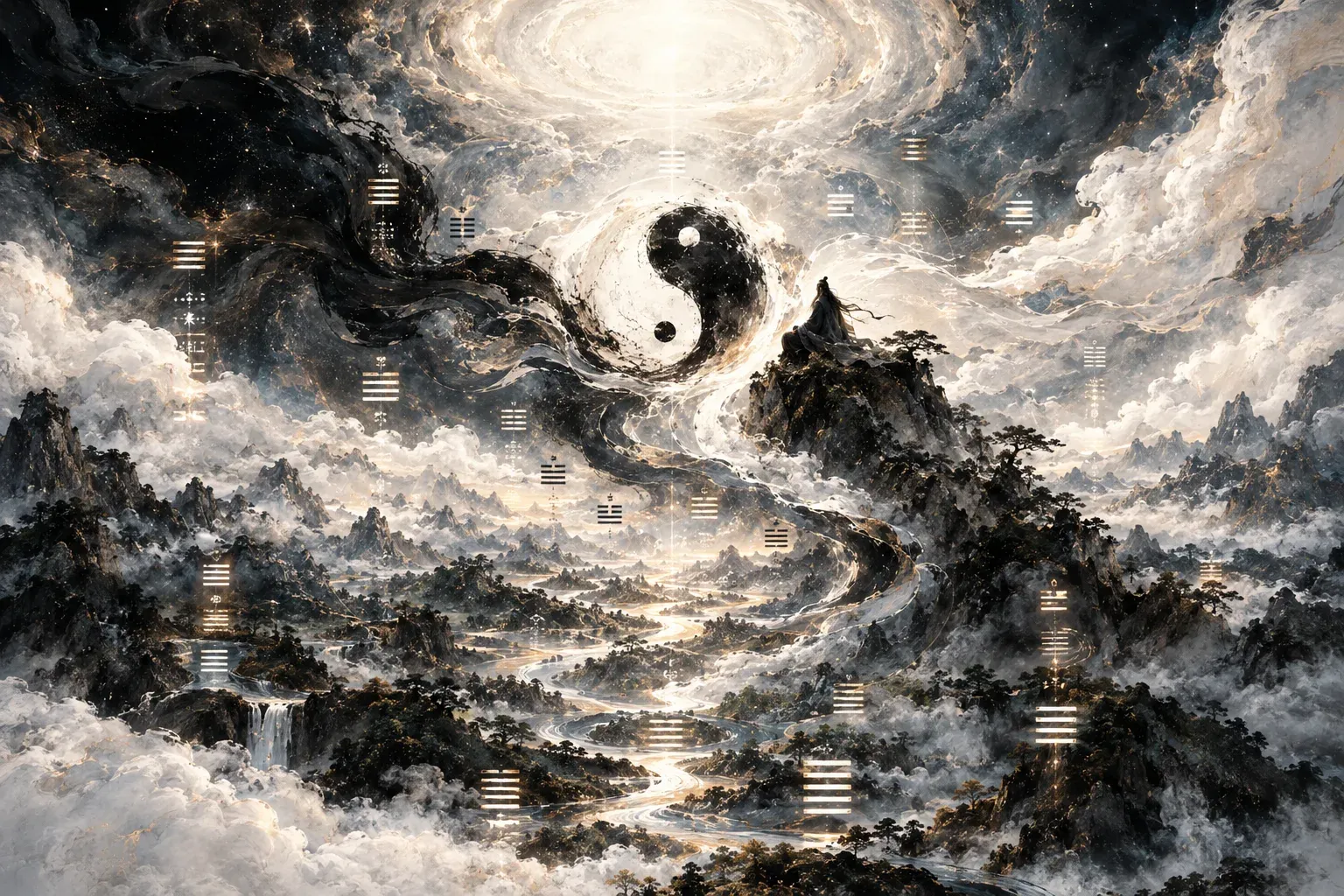
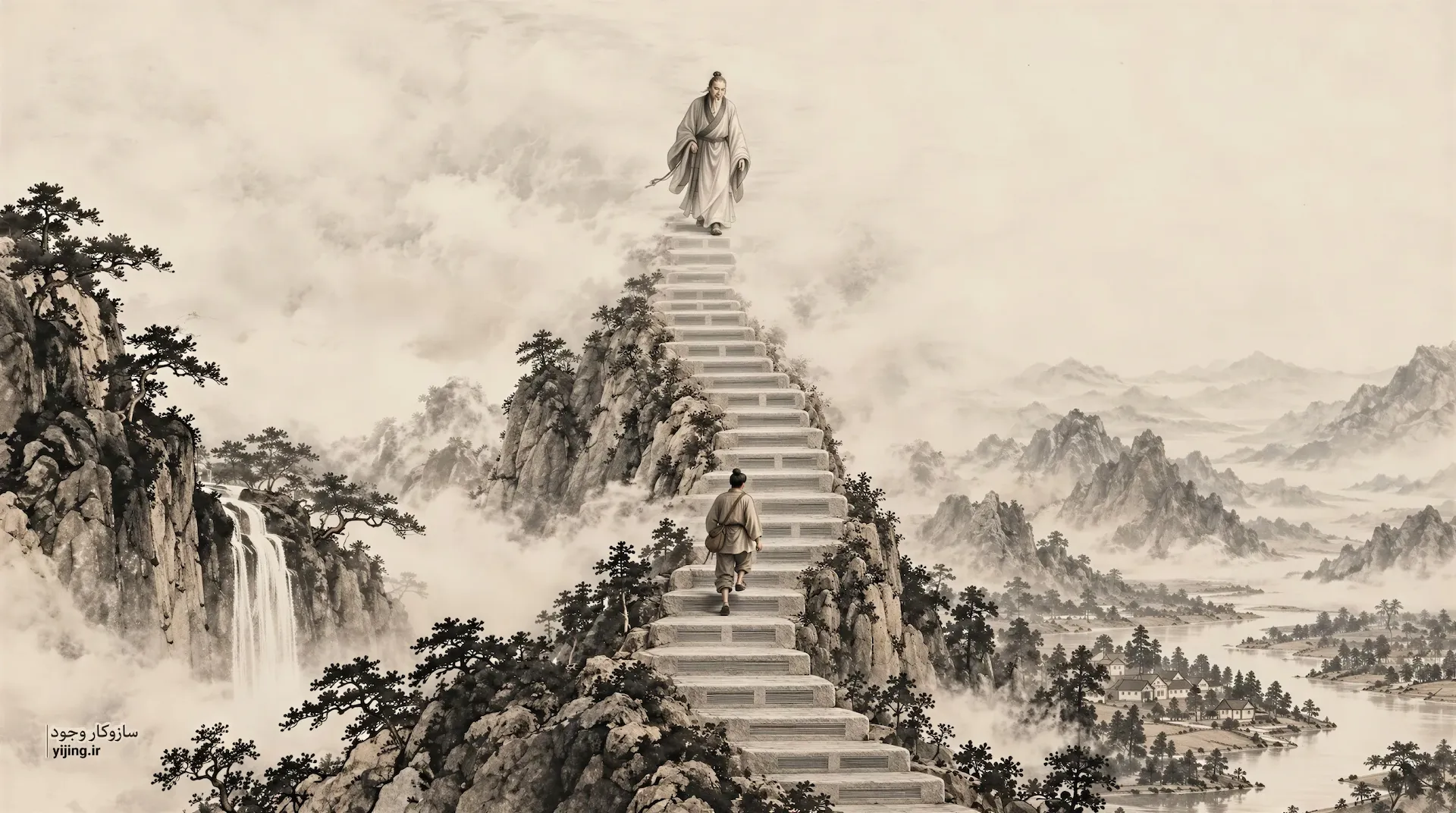

Wind is penetration and laying low, meaning gradually making progress by flexible obedience. In the body of the hexagram, one yin lies below two yangs; traveling the path of firmness by means of the path of flexibility, not hurrying yet not lagging, gradually progressing step by step, obedient within and obedient without, obedient below and obedient above, going from near to far, rising from low to high, like the wind going farther and higher as it blows, reaching everywhere, therefore this is called wind.
This hexagram represents progressing on the path by flexible obedience; it follows on the previous hexagram richness. In richness, understanding and action are united, so that one can deal with things adaptively, passive or active at will, essence and life depending on oneself and not on fate. However, the path of uniting understanding and action is not easily accomplished; it cannot be done without the work of gradual progress by flexible obedience. If one is flexible and obedient, one can endure long; by gradual progress one can penetrate. Flexible obedience making gradual progress, getting stronger with persistence, working without slacking off, will eventually arrive at deep attainment of self-realization. Therefore “wind is small but developmental.”
But though the ability to obey is a way of development, there are those who know about obedience but cannot practice it, there are those who can follow the low but not the high, there are those who can follow the high but not the low, there are those who can obey when it is pleasant but not when it is unpleasant, there are those who can obey in the beginning but not in the end—all of these are unable to really carry out the path of obedient progress, so even though they try to follow it they do not get through.
When we look for obedience in which knowledge and action are both effective, firmness and flexibility are employed together, able to be above and below, competent in both ease and adversity, effective both inwardly and outwardly, unified from start to finish, we find that only great people with balance and right orientation are capable of this. Therefore “it is beneficial to have somewhere to go,” and “it is beneficial to see a great person.”
A great person considers essence and life important, considers the Tao and its qualities valuable, looks upon the ephemeral body as like a dead tree, looks upon wealth and status as like floating clouds, is inwardly always more than fulfilled while outwardly appearing insufficient, truly applies real practical steps making gradual progress, mind firm and will far-reaching, determined not to rest until the great Path is completed. Therefore there is benefit. Those who are not great people cling to partiality; they obey and follow without balance or correct orientation—how can they get anywhere, to any benefit? So the benefit of going somewhere is only for the great person.
درباره این کتاب
عنوان اصلی:
The Taoist I Ching Translated by Thomas Cleary
ای جینگ دائویی
کتاب توماس کلیری (۱۹۸۶) نخستین ترجمهی انگلیسی است که شرح کامل «لیو ییمینگ» را همراه با متن ای جینگ در دسترس خوانندگان غربی قرار داد.
لیو ییمینگ (۱۷۳۴–۱۸۲۱ م.) از برجستهترین استادان مکتب دائوییِ کوانجِن (تمامیت حقیقت) در اواخر دوران سلسلهی چینگ بود. او نهتنها بهعنوان عارفی ژرفاندیش، بلکه بهعنوان یکی از مهمترین شارحان سنت نِیدان (کیمیاگری درونی) شناخته میشود؛ سنتی که هدف آن دگرگونی درونی و بازگشت به سرشت حقیقی و هماهنگی با دائو است از طریق فرایندی درونی و معنوی است. آثار او کوششی منسجم برای پیوند دادن آموزههای ای جینگ، دائوئیسم، بودیسم و کنفوسیوسیسم در چارچوبی واحد از خودپروری و سلوک معنوی به شمار میرود. از این منظر، نمادها و ششخطیهای ایجینگ صرفاً بیانگر رویدادهای جهان بیرونی نیستند، بلکه مراحل مختلف سلوک معنوی، پرورش یافتن ذهن، رشد آگاهی و بازگشت به هماهنگی با دائو را آشکار میکنند. به همین دلیل، شرح لیو ییمینگ بر ای جینگ از مهمترین و تأثیرگذارترین تفسیرهای عرفانی و نیدانی این کتاب در سنت فکری چین محسوب میشود.
لیو ییمینگ (۱۷۳۴–۱۸۲۱ م.) از برجستهترین استادان مکتب دائوییِ کوانجِن (تمامیت حقیقت) در اواخر دوران سلسلهی چینگ بود. او نهتنها بهعنوان عارفی ژرفاندیش، بلکه بهعنوان یکی از مهمترین شارحان سنت نِیدان (کیمیاگری درونی) شناخته میشود؛ سنتی که هدف آن دگرگونی درونی و بازگشت به سرشت حقیقی و هماهنگی با دائو است از طریق فرایندی درونی و معنوی است. آثار او کوششی منسجم برای پیوند دادن آموزههای ای جینگ، دائوئیسم، بودیسم و کنفوسیوسیسم در چارچوبی واحد از خودپروری و سلوک معنوی به شمار میرود. از این منظر، نمادها و ششخطیهای ایجینگ صرفاً بیانگر رویدادهای جهان بیرونی نیستند، بلکه مراحل مختلف سلوک معنوی، پرورش یافتن ذهن، رشد آگاهی و بازگشت به هماهنگی با دائو را آشکار میکنند. به همین دلیل، شرح لیو ییمینگ بر ای جینگ از مهمترین و تأثیرگذارترین تفسیرهای عرفانی و نیدانی این کتاب در سنت فکری چین محسوب میشود.
شش خطی 57
باد، پیشروی فروتنانه، نفوذی نرم (Xùn)
اسامی و مفاهیم دیگر: تأثیرات نرم، پیوسته و محکم، نماد خم شدن برای ورود، نفوذ باد، محاسبات، ملازمت، تواضع، خدمت متعهدانه
سنجش:
Wind is small but developmental. It is beneficial to have somewhere to go. It is beneficial to see a great person.
متن کنفوسیوس برای ششخطی «57» از کتاب «Cleary: Liu YiMing» ثبت نشده است.
تصویر:
Wind following wind. Thus do superior people articulate directions and carry out tasks.
Wind symbolizes gradually entering. Above and below is wind ; one wind arises first, another wind follows after. Wind following wind is the image of harmonious progress.
What superior people see in this is that since practitioners of the Tao live with people, they cannot but have tasks, and since they have tasks they must carry them out. Generally speaking, to carry out tasks calls for serenity, without rush. If one carries out tasks hurriedly and without first articulating directions for those who share in the tasks to clarify why they are thus and so, then people will not follow along, and the tasks will not be fulfilled. Therefore superior people first articulate directions and then carry out tasks.
Articulation means clarification; directions are instructions. Tasks are whatever people should do, things like cultivating character, accomplishing works, accumulating achievements and deeds, taking burdens upon oneself for the benefit of others. Directions are not only the orders of the rulers to the ruled; the instructions given by the honorable and experienced people who exercise leadership in affairs to less developed people are all called directions. If directions are articulated before tasks are carried out, then the people will know those tasks are to be done; one person takes the lead, and many people follow behind, so that all tasks are successfully carried out. This is like wind following wind, the two winds continuous, going together without mutual interference. This is the way superior people do good with others.
What superior people see in this is that since practitioners of the Tao live with people, they cannot but have tasks, and since they have tasks they must carry them out. Generally speaking, to carry out tasks calls for serenity, without rush. If one carries out tasks hurriedly and without first articulating directions for those who share in the tasks to clarify why they are thus and so, then people will not follow along, and the tasks will not be fulfilled. Therefore superior people first articulate directions and then carry out tasks.
Articulation means clarification; directions are instructions. Tasks are whatever people should do, things like cultivating character, accomplishing works, accumulating achievements and deeds, taking burdens upon oneself for the benefit of others. Directions are not only the orders of the rulers to the ruled; the instructions given by the honorable and experienced people who exercise leadership in affairs to less developed people are all called directions. If directions are articulated before tasks are carried out, then the people will know those tasks are to be done; one person takes the lead, and many people follow behind, so that all tasks are successfully carried out. This is like wind following wind, the two winds continuous, going together without mutual interference. This is the way superior people do good with others.
خط اول:
Advancing and retreating, it is beneficial to be steadfast like a soldier.
When weak and hesitant, retreating as soon as one advances, one will never attain deeply. However, everyone has a share in the universal Tao; the only trouble is they lack will. If you can be determined, and approach true teachers, seeking personal instruction, striving mightily with the steadfastness of a soldier, you can enter the Tao beneficially. This is obedience by which the weak borrow strength.
خط دوم:
Obedient in the basement, frequently employing intermediaries, leads to good fortune, without blame.
Using strength with flexibility, not becoming inflated or complacent, humbling oneself to others, is like “obedience in the basement, frequently employing intermediaries.” Not only does one govern oneself auspiciously, one also deals with other people blamelessly. This is the obedience of the strong who are able to be flexible and to yield.
خط سوم:
Redundant obedience is humiliating.
When one is self-satisfied, considering oneself while disregarding others, one cannot open the mind to ask for instruction, obeying those who are superior from an inferior position, and so one uses one’s own intellectual brilliance to conform with the superior from a position of superiority; originally one wanted to go forward, but instead one falls behind. This is called redundant obedience. When obedience gets to redundancy, one can go along with those who agree, but not with those who disagree. Sometimes docile, sometimes not, one gets only humiliation. This is the obedience of the strong who cannot be flexible.
خط چهارم:
Regret vanishes. The yield of the field is of three grades.
When one is only flexible and has no strength or firmness, it seems like one is too weak to reach deep attainment, and so there is regret. However, when flexibility is correctly oriented, near to superior strength, obedience following superiority gains balance thereby. This is one grade of “yield,” the superior. When one approaches strength in a lower position, obedience following the strength below and being balanced thereby, this is the inferior grade of yield. As yin dwells in the midst of yang, not losing correctness regardless of accord or opposition is the middling grade of yield. When the three grades of great medicine, superior, middling, and inferior, return to the center, yin and yang merge, the gold elixir takes on form; this is purely the living potential. It is like planting crops in the fields, all of them maturing. What regret will not vanish? This is the obedience of balance and rectitude when weak.
خط پنجم:
It is good to be correct; regret vanishes. There is all-around benefit. There is no beginning, but there is an end. The last three days of the lunar cycle and the first three days of the lunar cycle are auspicious.
When one is strong and yet can still be obedient, being meticulous and single-minded, holding faithfully to the center, thereby whatever regret there was can vanish, and there is all-around benefit to the practice of Tao. That benefit is because the great person who is strong yet can yield is able to follow and also to lead. Starting out by obediently humbling oneself, it seems as if yielding injures strength—this is “no beginning.” Having followed the way up, one is able to use flexibility to complete strength, so “there is an end.”
The image of there being no beginning yet there being an end is as of the last three days and the first three days of the lunar cycle. The last three days start on the twenty-eighth of the lunar month, and first three days end on the third. On the twenty-eighth, the slight yang fades in the northeast, till the light finally becomes completely hidden on the thirtieth. At the new moon, the moon is tinged with the light of the sun; this is concealing yang within yin. By the third day, light like a wispy eyebrow appears in the west. The last three days of waning represent obedience concealing positive energy; the first three days of waxing represent obedience furthering positive energy.
The path of spiritual alchemy first follows lowliness to deep attainment, using flexibility and yielding, then follows the superior to self-realization, completing firm strength. Including yang within yin, using yin within yang, great and small are undamaged, completely balanced and correct, so the gold elixir crystallizes. The advantage of obedience in strength is most great. This is obedience using both strength and flexibility.
The image of there being no beginning yet there being an end is as of the last three days and the first three days of the lunar cycle. The last three days start on the twenty-eighth of the lunar month, and first three days end on the third. On the twenty-eighth, the slight yang fades in the northeast, till the light finally becomes completely hidden on the thirtieth. At the new moon, the moon is tinged with the light of the sun; this is concealing yang within yin. By the third day, light like a wispy eyebrow appears in the west. The last three days of waning represent obedience concealing positive energy; the first three days of waxing represent obedience furthering positive energy.
The path of spiritual alchemy first follows lowliness to deep attainment, using flexibility and yielding, then follows the superior to self-realization, completing firm strength. Including yang within yin, using yin within yang, great and small are undamaged, completely balanced and correct, so the gold elixir crystallizes. The advantage of obedience in strength is most great. This is obedience using both strength and flexibility.
خط ششم:
Obedient under the floor, one loses one’s resources; even if faithful, there is misfortune.
At the culmination of obedience, the work of following lowliness is done, and one should withdraw from the path of yielding and proceed on the path of firmness, whereby to transmute all negativities. At this time one should not follow the low, but should follow the high, standing on top of the floor. If one clings and does not pass on, one who should be on top of the floor will wind up “under the floor.” When yielding prevails over firmness, negative energy is not transmuted, and inevitably the great medicine obtained will be lost again, so that one’s efforts will have been wasted. So it is logical that even if faithful, there will be misfortune. This is obedience in which yielding exceeds firmness.
So the path of progress through obedience gradually penetrating requires recognition of when to hurry and when to relax, discernment of what is conducive to good results and what leads to bad results, and the knowledge to stop at sufficiency. One must be firm when necessary, be flexible when necessary, using firmness and flexibility at the appropriate times, accordingly advancing to the balance of firmness and flexibility. This is the ultimate accomplishment.
So the path of progress through obedience gradually penetrating requires recognition of when to hurry and when to relax, discernment of what is conducive to good results and what leads to bad results, and the knowledge to stop at sufficiency. One must be firm when necessary, be flexible when necessary, using firmness and flexibility at the appropriate times, accordingly advancing to the balance of firmness and flexibility. This is the ultimate accomplishment.
So the path of progress through obedience gradually penetrating requires recognition of when to hurry and when to relax, discernment of what is conducive to good results and what leads to bad results, and the knowledge to stop at sufficiency. One must be firm when necessary, be flexible when necessary, using firmness and flexibility at the appropriate times, accordingly advancing to the balance of firmness and flexibility. This is the ultimate accomplishment.
پس مسیر پیشروی از طریق اطاعتِ بهتدریج نفوذکننده، نیازمند آن است که انسان بداند چه زمانی باید شتاب کرد و چه زمانی باید آرام گرفت، و همچنین بتواند میان آنچه که منجر به نتایج سودمند میشود و آنچه که به نتایج بد میانجامد، تمایز قائل شود. همچنین باید دانش توقف در حد کفایت را دارا بود. باید در زمان لازم، استوار بود و در زمان نیاز، انعطافپذیر؛ و این استواری و انعطافپذیری باید در زمان مناسب به کار گرفته شود. به این ترتیب، انسان به تعادل درونی میان سختی و نرمی دست مییابد که این، خود کمال نهایی است. (ییمینگ)
این یک شش خطی بسیار امیدوار کننده و نوید بخش است؛ این برای کسانی که پذیرش داشته باشند و به شرایط به خوبی تن دهند مقدار مشخصی از موفقیت را نشان میدهد -- مگر مسیر تغییر(بخش مسیر) مخالف این شرایط را نشان دهد. اکنون زمان مقاومت نیست بلکه زمان تسلیم بودن و پذیرش داشتن است. (بلوفلد)
این شش خطی وضعیت شما را به لحاظ تأمین پشتیبانیهای نامحسوس توضیح میدهد. تأکید میکند نفوذ نامحسوس و پرداختن به چیزها به صورت ظریف، به روش زمین، شیوهی مناسب در این وضعیت است. برای همسازی با زمانه، به شما گفته شده از پایین(فروتنانه) وارد ماجرا شوید. (ریتسما/کراچر)
بنابراین رهرو باید حد اعلای نیروی ذهنش را به کار بگیرد. اگر چنین کند، ذات خودش را خواهد شناخت. و اگر ذات خودش را بشناسد، خودش را بیازماید و با خود صادق شود، خردمند خواهد شد. از این رو شیوهی برتر میگوید: فضیلت تفکر در نفوذ و ژرف بودنش است... نفوذ و ژرفایی به خردمندی میانجامد. (چنگ ای ـ فیلسوف چینی ۱۱م)
تجربهها و سوالات 57
جالبه که توی ی مسئله عاطفی دوبار در دو زمان مختلف به ایی چینگ رجوع کردم.و هر دو پاسخ شش خطی ۵۷ بود.
درودوادب
سوالم کردم،بعدازبی عدالتی وناحقی آشکارکه دردادگاه بابت یک تصادف برایم رقم خوردن باید چه واک...
گفتارهای شش خطی 57