
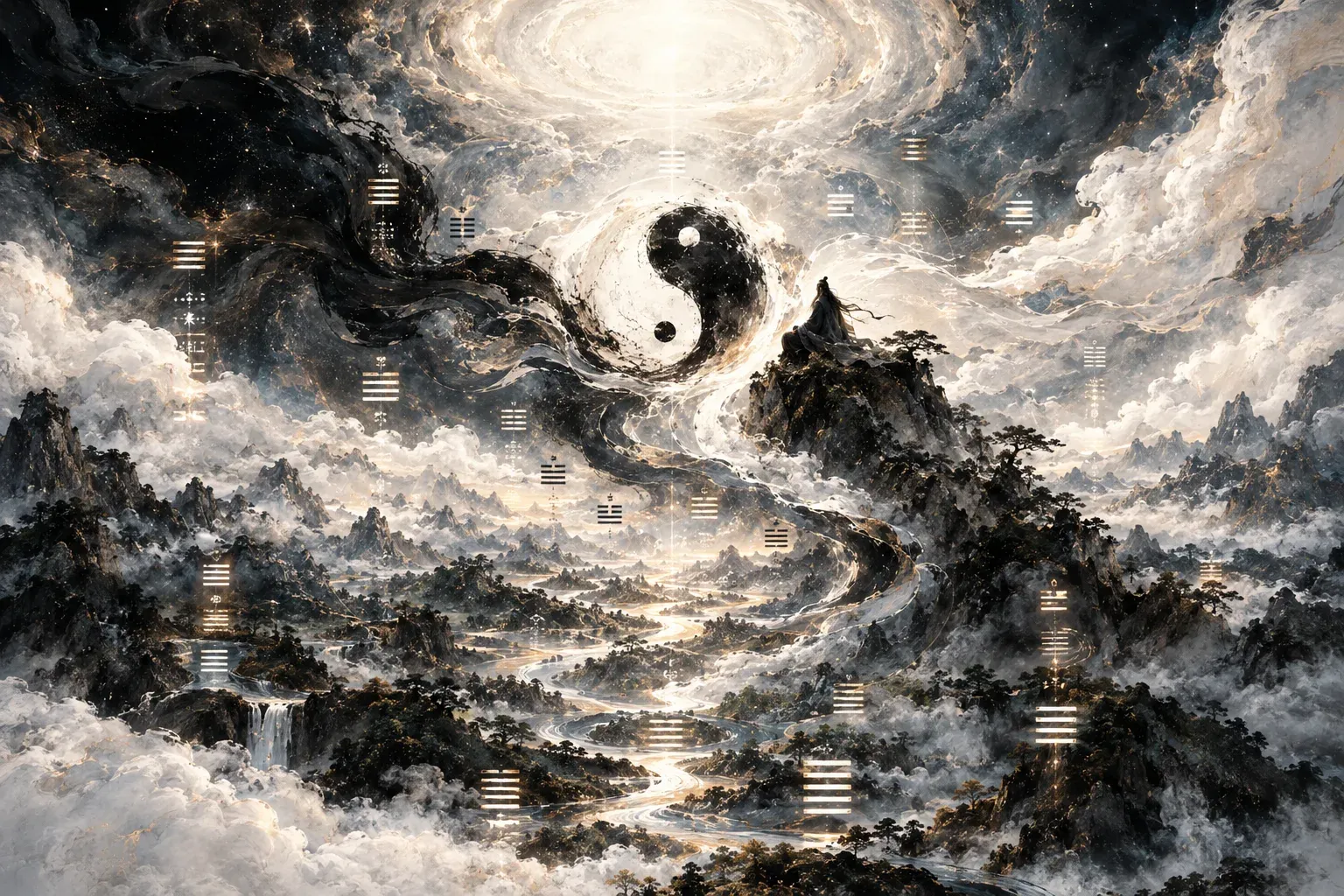
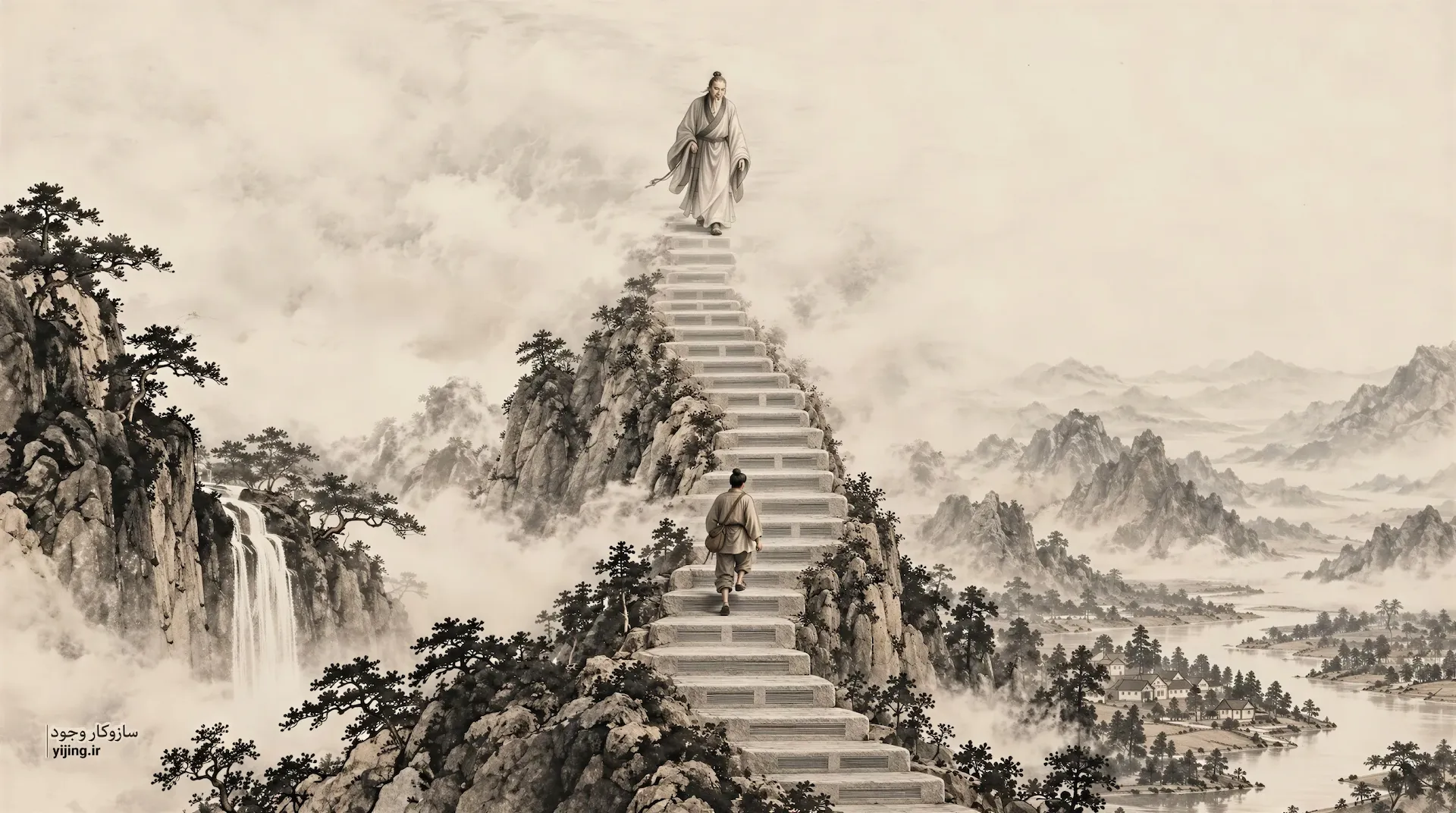

Travel means passing through and not lingering. As to the qualities of the hexagram, above is fire , luminous, and below is mountain , still: Using illumination with stability, illumination being based on stillness, one stabilizes the illumination and does not use it carelessly. Therefore this is called travel.
This hexagram represents nurturing the fire and transcending the world; it follows on the previous hexagram making a young girl marry. In making a young girl marry, there is uncontrolled action based on emotion, obeying the mundane energy of conditioning and burying the primal celestial energy, taking the artificial to be real, taking misery for pleasure. Practitioners of Tao should first see through worldly things, looking upon all conditions, all existents, as passing by, not injuring the real by delighting in the false, not disturbing the inward because of the outward. Understanding stillness and staying in the proper place, stabilizing illumination so that it is not damaged, when illumination and stillness are used together one can thereby transcend the world while in the world. Therefore travel is developmental when small, and travel leads to good fortune when correct.
“Small” travel means applying illumination with stillness, so that illumination is not used arbitrarily. The good fortune of correctness is when illumination is based on stillness, resting in ultimate good. Applying illumination with stillness, one forgets feelings in the face of objects. When illumination is based on stillness, one ejects extreme intellectualism. Unperturbed, like a mountain stably resting on the earth, unbefuddled, like the sunlight shining in the sky, inwardly there is no disturbance, outwardly there is no obscurity: When there is something to do, you use clarity to deal with it; when there is nothing to do, you use clarity to remain still. You are then free from greed and craving, not expecting or pursuing, not lingering or tarrying.
In general, travel as a path means just passing through once—you should not remain attached to the realm you pass through. If you are concerned with externals, you forget the inward; by pursuing ramifications you abandon the root. When illumination is called for, then be aware; but while aware still remain calm. When stillness is called for, be still; but while still, remain aware. When illumination and stability, awareness and stillness, are unified, how can there be failure to develop and prosper?
درباره این کتاب
عنوان اصلی:
The Taoist I Ching Translated by Thomas Cleary
ای جینگ دائویی
کتاب توماس کلیری (۱۹۸۶) نخستین ترجمهی انگلیسی است که شرح کامل «لیو ییمینگ» را همراه با متن ای جینگ در دسترس خوانندگان غربی قرار داد.
لیو ییمینگ (۱۷۳۴–۱۸۲۱ م.) از برجستهترین استادان مکتب دائوییِ کوانجِن (تمامیت حقیقت) در اواخر دوران سلسلهی چینگ بود. او نهتنها بهعنوان عارفی ژرفاندیش، بلکه بهعنوان یکی از مهمترین شارحان سنت نِیدان (کیمیاگری درونی) شناخته میشود؛ سنتی که هدف آن دگرگونی درونی و بازگشت به سرشت حقیقی و هماهنگی با دائو است از طریق فرایندی درونی و معنوی است. آثار او کوششی منسجم برای پیوند دادن آموزههای ای جینگ، دائوئیسم، بودیسم و کنفوسیوسیسم در چارچوبی واحد از خودپروری و سلوک معنوی به شمار میرود. از این منظر، نمادها و ششخطیهای ایجینگ صرفاً بیانگر رویدادهای جهان بیرونی نیستند، بلکه مراحل مختلف سلوک معنوی، پرورش یافتن ذهن، رشد آگاهی و بازگشت به هماهنگی با دائو را آشکار میکنند. به همین دلیل، شرح لیو ییمینگ بر ای جینگ از مهمترین و تأثیرگذارترین تفسیرهای عرفانی و نیدانی این کتاب در سنت فکری چین محسوب میشود.
لیو ییمینگ (۱۷۳۴–۱۸۲۱ م.) از برجستهترین استادان مکتب دائوییِ کوانجِن (تمامیت حقیقت) در اواخر دوران سلسلهی چینگ بود. او نهتنها بهعنوان عارفی ژرفاندیش، بلکه بهعنوان یکی از مهمترین شارحان سنت نِیدان (کیمیاگری درونی) شناخته میشود؛ سنتی که هدف آن دگرگونی درونی و بازگشت به سرشت حقیقی و هماهنگی با دائو است از طریق فرایندی درونی و معنوی است. آثار او کوششی منسجم برای پیوند دادن آموزههای ای جینگ، دائوئیسم، بودیسم و کنفوسیوسیسم در چارچوبی واحد از خودپروری و سلوک معنوی به شمار میرود. از این منظر، نمادها و ششخطیهای ایجینگ صرفاً بیانگر رویدادهای جهان بیرونی نیستند، بلکه مراحل مختلف سلوک معنوی، پرورش یافتن ذهن، رشد آگاهی و بازگشت به هماهنگی با دائو را آشکار میکنند. به همین دلیل، شرح لیو ییمینگ بر ای جینگ از مهمترین و تأثیرگذارترین تفسیرهای عرفانی و نیدانی این کتاب در سنت فکری چین محسوب میشود.
شش خطی 56
سفر کردن (Lǚ)
اسامی و مفاهیم دیگر: مسافر، غریبه، گذر کردن، ناپایداری، سرگردان، مهمانخانه، سفر، تبعید، بیگانه، بی خانمان، تنها، رویارویی با ناشناختهها، نماد مسافر، خانه به دوش
سنجش:
Travel is developmental when small; if travel is correct, it leads to good fortune.
متن کنفوسیوس برای ششخطی «56» از کتاب «Cleary: Liu YiMing» ثبت نشده است.
تصویر:
There is fire atop a mountain, transient. Thus superior people apply punishment with understanding and prudence, and do not keep people imprisoned.
Transience means passing on, not remaining. Above is fire , below is mountain ; there is fire atop a mountain. Fire atop a mountain does not burn for long; it passes through once and is over. This is the image of transience.
What superior people see in this is that the penal system relates to human nature and life; if judgment is passed without understanding, the falsely accused cannot receive justice, and if punishment is inappropriately applied, the innocent are harmed. Therefore superior people emulate the illumination of fire to clearly discern what is unjust and what is just, to affirm what is right and repudiate what is wrong. For those who have done wrong, this means to accept punishment with good grace. Superior people also emulate the caring warmth of mountains, being careful and prudent about punishment, making it light where possible, reducing it where possible. For those in charge of applying the law, this means not being arbitrary in punishment. With understanding and prudence, matters are settled as they are dealt with, and people are not kept imprisoned with suspicion and doubt and treated cruelly.
In practice of the Tao, the use of understanding is to break through delusion; being prudent and not overusing that understanding is the way to nurture reality. Through understanding and prudence, falsehood is done away with and truth is kept; then one can stop striving and take to nonstriving. This is like applying punishment with understanding and prudence and not keeping people imprisoned. If you do not know to stop at sufficiency, but keep on fussing, you will again call on delusion where there is no delusion, and produce mental illness. How then can you attain the state where one comprehension applies to everything?
In the image of the hexagram, there is fire on a mountain. The mountain is the substance, the fire is the function: Understanding what should be understood, stopping when one should stop, clarity is not separated from stillness; one clarifies the quality of illumination, and rests in the highest good.
What superior people see in this is that the penal system relates to human nature and life; if judgment is passed without understanding, the falsely accused cannot receive justice, and if punishment is inappropriately applied, the innocent are harmed. Therefore superior people emulate the illumination of fire to clearly discern what is unjust and what is just, to affirm what is right and repudiate what is wrong. For those who have done wrong, this means to accept punishment with good grace. Superior people also emulate the caring warmth of mountains, being careful and prudent about punishment, making it light where possible, reducing it where possible. For those in charge of applying the law, this means not being arbitrary in punishment. With understanding and prudence, matters are settled as they are dealt with, and people are not kept imprisoned with suspicion and doubt and treated cruelly.
In practice of the Tao, the use of understanding is to break through delusion; being prudent and not overusing that understanding is the way to nurture reality. Through understanding and prudence, falsehood is done away with and truth is kept; then one can stop striving and take to nonstriving. This is like applying punishment with understanding and prudence and not keeping people imprisoned. If you do not know to stop at sufficiency, but keep on fussing, you will again call on delusion where there is no delusion, and produce mental illness. How then can you attain the state where one comprehension applies to everything?
In the image of the hexagram, there is fire on a mountain. The mountain is the substance, the fire is the function: Understanding what should be understood, stopping when one should stop, clarity is not separated from stillness; one clarifies the quality of illumination, and rests in the highest good.
خط اول:
Restless in travel, this is the misfortune you get.
When you are weak and unclear, unable to see through worldly things, not knowing where to stop, restlessly traveling here, traveling there, you bring misfortune on yourself. This is the travel of the weak and disoriented.
خط دوم:
Coming to a lodge on a journey with money in your pocket, you have attendants, yet are upright.
Flexible receptivity in balance, staying in the appropriate place, is like coming to a lodge on a journey with money in your pocket. Having substance, yet you mix in with others, living with lesser people, while able to avoid being influenced by lesser people. This is what is called adapting to situations as they are, not letting people know what is hidden under your actions. This is travel with flexibility, balance, and rectitude.
خط سوم:
Burning the lodge on a journey, you lose your attendants. Even if righteous there is danger.
When you are firm without flexibility, are unable to still inside and insist on stillness outside, totally cutting off social relations, upsetting the ignorant and ordinary, this is like burning the lodge on a journey, losing your attendants. On a journey on which you burn the lodge, though your travel may be correct, you arouse the hatred and suspicion of others, so this still is a road that brings on danger and disaster. This is travel in which firmness is excessive.
خط چهارم:
Traveling in the right place, one obtains resources and tools, but one’s heart is not happy.
When one is strong and also illumined, it is like travelling in the right place; one is in control. After having completed oneself, one should also develop others; one may thus form relationships wherever one may be, build up virtue and accumulate good deeds, without difficulty. However, the correspondents are all negative (the fourth line corresponds with the first, which is yin)—even though one has resources and tools, if there are none who understand one cannot fulfill one’s aspiration, and therefore one’s heart is not happy. This has been the case time and again with those since ancient times who have had resources and tools but have been unable to carry forth the Path to any great extent. This is travel where one is strong but doesn’t find the right time.
خط پنجم:
Shooting pheasant, one arrow is lost; eventually one is entitled, because of good repute.
Being flexible and receptive, open and balanced, is like “shooting pheasant, one arrow is lost.” “Shooting pheasant” means not using illumination; “one arrow is lost” means not using strength. Not using illumination, illumination is replete; not using strength, strength is complete—the whole psychophysical being is sublimated, and one lets things be as they are. Not losing oneself, neither does one turn away from others. One’s virtue is sufficient to move people, and eventually one is entitled because of good repute. This is travel with flexibility and ability to integrate.
خط ششم:
A bird turns its nest. The traveler first laughs, afterward cries. Losing the ox at the border, there is misfortune.
When one presumes on strength in using intellect, aggrandizing oneself, knowing how to criticize others but not how to criticize oneself, not benefiting others and even harming oneself, this is like the travel of a bird burning its nest; first there is laughter, afterward weeping. Starting out by employing clarity, winding up by destroying clarity, and misfortune of “losing the ox at the border” is inevitable here. This is travel in which understanding is misused.
Of the travel indicated in the six lines, sometimes it is travel inside, sometimes it is travel outside; sometimes there is firmness in travel, sometimes there is flexibility in travel. Stillness within and travel without is found only in the yin in the second place. Emptying the self and traveling to others is only in the yin in the fifth place. Those who know this path can deal with the world without destroying the world, and can transcend the world while in the world.
Of the travel indicated in the six lines, sometimes it is travel inside, sometimes it is travel outside; sometimes there is firmness in travel, sometimes there is flexibility in travel. Stillness within and travel without is found only in the yin in the second place. Emptying the self and traveling to others is only in the yin in the fifth place. Those who know this path can deal with the world without destroying the world, and can transcend the world while in the world.
Of the travel indicated in the six lines, sometimes it is travel inside, sometimes it is travel outside; sometimes there is firmness in travel, sometimes there is flexibility in travel. Stillness within and travel without is found only in the yin in the second place. Emptying the self and traveling to others is only in the yin in the fifth place. Those who know this path can deal with the world without destroying the world, and can transcend the world while in the world.
به دلیل بیرون بودن، یک ماجرا را سفر مینامند. هنگام سفر، انعطافپذیر بودن بهترین و مهمترین چیز است و در بهکارگیری انعطافپذیری، متعادل بودن بهترین چیز است. هنگامی که متعادل باشیم، میتوانیم با قدرت هماهنگ شویم، بهگونهای که جایی در جهان نباشد که بودن در آن دشوار باشد. با حفظ آرامش خود میتوانیم هرجا که هستیم، در آسودگی باشیم. با ماندن با درک درست، میتوان فرصتها را دید و عمل کرد.
درستی این سفر همان درستی آفریننده(ششخطی ۱)، پذیرنده(ششخطی دوم) و کل فرآیند(ششخطیهای ۳ تا ۶۴) است. حکیمان فرزانه در تمام دورانها، از امپراتورها تا عوام، همهی سفر را کاملاً از منظر درستی آفریننده، پذیرنده و کل فرآیند در نظر گرفتهاند، بنابراین هنگامی که سفر میکنند، کاملاً درستی آفریننده، درستی پذیرنده و درستی کل فرآیند را درک میکنند. چگونه کسی میتواند آنقدر بیاحتیاط باشد که اهمیت بزرگ زمانی که در آن هست را نادیده بگیرد؟ (چیشو)
در میان انواع سفرهایی که در این شش خط نشان داده شدهاند، گاهی سفر درونی است، گاهی بیرونی؛ گاهی در سفر سختی وجود دارد، گاهی نرمی. سکون و آرامیدگی در درون و سفر در بیرون تنها در یینِ جایگاه دوم یافت میشود. خالی کردن خویش و سفر به سوی دیگران تنها در یینِ جایگاه پنجم است. کسانی که این راه را میشناسند، میتوانند با جهان تعامل کنند بیآنکه آن را نابود سازند، و میتوانند از جهان فراتر روند در حالی که در آن باقی میمانند. (ییمینگ)
اما پویندگان راهِ دائو باید نخست امور دنیوی را دریابند و گذرا بودن همهی شرایط و همهی موجودات را ببینند، بدون آنکه با مجذوب شدن و لذت بردن از باطل(فانی، ناپایدار، گذرا) به حق(پایدار، همیشگی) آسیب برسانند یا درون را به سبب بیرون دچار آشفتگی سازند. (ییمینگ)
تجربهها و سوالات 56
من این نیت روبرای اخرت خودم گرفتم یکی پیش ازپایان امد وبرای انتها هم مسافرکه خودش دراخردقیقا اشاره م...
من واسه بیماری یک نفر پرسیدم که اگه این راه را انتخاب کنه چه دستاوردی داره خط 56 اومد منظور چیه؟
سپا...
خیلی جالب! چند ماهی است که به شهر دیگری آمدهایم و با اینکه از همان ابتدا با همسایگان مهربان و صمیم...
گفتارهای شش خطی 56