
1.
In the distant past, the way the sage1 made the Changes is as follows: He was mysteriously assisted by the gods [shenming, literally, “the numinous and the bright”] and so initiated the use of yarrow stalks. {H.K: Mysteriously means “profoundly,” and assisted means “enlightened.” The yarrow stalks respond to commands as if they were echoes. How they manage to do this defies understanding—it just happens!2} He made Heaven three and Earth two and so provided the numbers with a basis. {H.K: Three signifies the odd numbers, and two signifies the even numbers; seven and nine are yang [odd] numbers, and six and eight are yin [even] numbers.} He observed the changes between yin and yang and so established the trigrams. {H.K: The trigrams constitute the images, and the yarrow stalks constitute the numbers. As for the trigrams, these render yin and yang into comparable images and so constitute embodiments of transformation and change, such as “Thunder and Wind give rise each to the other” or “Mountain and Lake reciprocally circulate material force.”3 As for the yarrow stalks, these constitute the odd and even numbers that intermingle the elements of Heaven and Earth. The yarrow stalks exhaust all the numbers and in so doing establish the images. The trigrams complete the images and in so doing use up all the numbers. This is why the yarrow stalks are referred to in the terms “He made Heaven three and Earth two and so provided the numbers with a basis,” and why the trigrams are referred to in the terms “He observed the changes between yin and yang [and so established them].”} As the trigrams are begun and are dispersed through the movement of the hard and soft lines, he initiated the use of such lines. {H.K: The hard and the soft lines begin and disperse them; it is the movement of change that brings them together.} He was in complete accord with the Dao and with Virtue, and the principles involved conform to rightness. He exhausted principles to the utmost and dealt thoroughly with human nature, and in doing so arrived at the workings of fate. {H.K: Fate is the ultimate reach of life. To exhaust principles to the utmost is to explore fate to the ultimate degree.}
2.
In the distant past, the way the sages4 made the Changes was as follows: It was to be used as a means to stay in accord with the principles of nature and of fate. It was for this reason that they determined what the Dao of Heaven was, which they defined in terms of yin and yang, what the Dao of Earth was, which they defined in terms of hard and soft, {H.K: “In Heaven this [process] creates images, and on Earth it creates physical forms.”5 Yin and yang are terms that address things as aspects of material force, and hard and soft are terms that address them as kinds of physical forms. Change and transformation begin with the images of material force and only then go on to create physical forms. The natural endowments of the myriad things begin in Heaven and take on physical forms on Earth. Therefore, when Heaven is involved, we refer to things in terms of yin and yang, and when Earth is involved, we refer to things in terms of soft and hard. One might refer to things that exist as physical forms as either yin or yang; this is to trace them back to their origins. One might refer to things that exist as material forces as either hard or soft; this is to sum up their endings.6} and what the Dao of Man was, which they defined in terms of benevolence and righteousness. They brought these three powers together and doubled them; this is why the Changes forms its hexagrams out of six lines. They provided yin allotments and yang allotments, so their functions alternate between soft and hard; this is why the Changes forms its patterns out of six positions. {H.K: They established the six lines in order to replicate the actions of the three powers; this is why it takes six lines. The six positions are the places that the lines occupy. The second and the fourth positions are yin, and the third and the fifth are yang. This is why the text says: “They provided yin allotments and yang allotments.” As the six lines ascend or descend, sometimes they are in hard positions and sometimes in soft. This is why the text says: “Their functions alternate between soft and hard.”}
3.
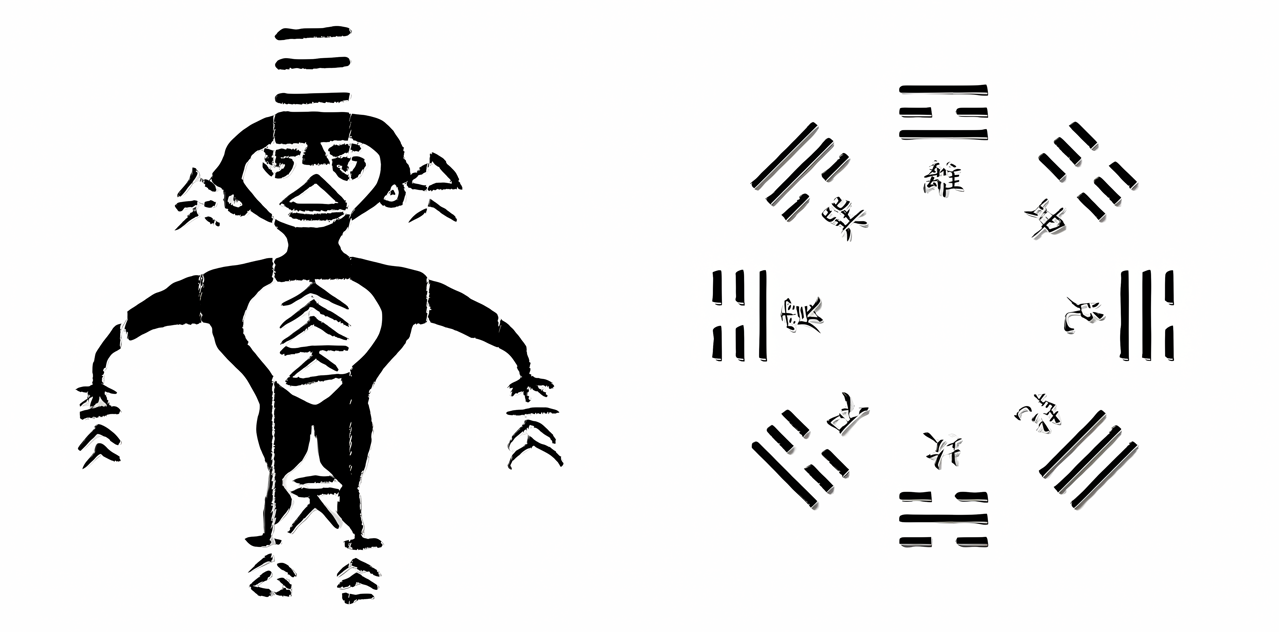
As Heaven [Qian, Pure Yang] and Earth [Kun, Pure Yin] establish positions, as Mountain [Gen, Restraint] and Lake [Dui, Joy] reciprocally circulate material force, as Thunder [Zhen, Quake] and Wind [Sun, Compliance] give rise each to the other, and as Water [Kan, Sink Hole] and Fire [Li, Cohesion] do not fail to complement each other, the eight trigrams combine with one another in such a way that, to reckon the past, one follows the order of their progress, and, to know the future, one works backward through them. {H.K: With the combination of the eight trigrams, all the principles involved with change and transformation are complete. In regard to the past, one gets to know it by going with the flow [up to the present], and, in regard to the future, one reckons it by working backward [to the present].} Therefore, the Changes allow us to work backward [from the future] and reckon forward [from the past]. {H.K: The sages made the Changes in order to gain a view back [from the future] and “to provide beforehand for the needs of the common folk.”7}
4.
It is by Thunder [Zhen, Quake] that things are caused to move, by Wind [Sun, Compliance] that they are dispersed, by the Rain [Kan, Sink Hole, i.e., Water] that they are moistened, by the Sun [Li, Cohesion, i.e., Fire] that they are dried, by Restraint [Gen] that they are made to stop, by Joy [Dui] that they are made happy, by Pure Yang [Qian, i.e., Heaven] that they are provided with a sovereign, and by Pure Yin [Kun, i.e., Earth] they are harbored.
5.
The Divine Ruler [shangdi] comes forth in Zhen [Quake] and sets all things in order in Sun [Compliance], makes them visible to one another in Li [Cohesion, i.e., Sun, Fire], gives them maximum support in Kun [Pure Yin, i.e., Earth], makes them happy then in Dui [Joy], has them do battle in Qian [Pure Yang], finds them thoroughly worn out in Kan [Water Hole], and has them reach final maturity in Gen [Restraint].
The myriad things come forth in Zhen [Quake]; Zhen corresponds to the east. They are set in order in Sun [Compliance]; Sun corresponds to the southeast. “Set in order” means that they are fresh and neat. Li [Cohesion, Fire, i.e., the sun] here means brightness. That the myriad things are made visible to one another here signifies that this is the trigram of the south. The fact that the sage [king] faces the south to listen to the whole world and that he turns toward the brightness there to rule is probably derived from this. Kun [Pure Yin, Earth] here means the Earth. The myriad things all are nourished to the utmost by it. This is why it says: “gives them maximum support in Kun.” Dui [Joy] here means autumn at its height, something in which the myriad things all find cause to rejoice. This is why it says: “makes them happy then in Dui.” [As for] “has them do battle in Qian” Qian here is the trigram of the northwest, so this signifies where yin and yang exert pressure on each other. Kan [Sink Hole] here means water. It is the trigram of due north. It is the trigram of wearisome toil. It is here that the myriad things all find refuge. This is why it says: “finds them thoroughly worn out in Kan.” Gen [Restraint] is the trigram of the northeast. It is here that the myriad things reach the end of their development, but it is also the beginning of that development. This is why it says: “has them reach final maturity in Gen.”
6.
As for the numinous, it is the term used for that which invests the myriad things with the marvel of what they are and do. {H.K: The numinous is introduced at this point to clarify the fact that no external agent is involved in the way the [primal forces of the] eight trigrams move and exert themselves so that things undergo change and transformation and exchange places with one another. The numinous thus does not exist as a thing but “is the term used for that which invests the myriad things with the marvel of what they are and do.” Thunder as such is swift, Wind fleet, Fire burns, and Water is wet; each spontaneously and naturally undergoes change, transforming one into the other. This is how the myriad things acquire the capability to become all that they can be.} Of things that make the myriad things move, none is swifter than Thunder. Of things that make the myriad things bend, none is swifter than the Wind. Of things that make the myriad things dry, none is a better drying agent than Fire. Of things that make the myriad things rejoice, none is more joy giving than the Lake. Of things that moisten the myriad things, none is more effective than Water. Of things that provide the myriad things with ends and beginnings, none is more resourceful than Restraint. This is why Water and Fire drive each other on, why Thunder and Wind do not work against each other, and why “Mountain and Lake reciprocally circulate.”8 Only in consequence of all this can change and transformation take place, thus allowing the myriad things to become all that they can be.
7.
Qian [Pure Yang] means strength and dynamism [jian]; Kun [Pure Yin] means submissiveness and pliancy; Zhen [Quake] means energizing; Sun [Compliance] means accommodation; Kan [Water] means pitfall; Li [Cohesion] means attachment; Gen [Restraint] means cessation; Dui [Joy] means to delight.
8.
Qian [Pure Yang] has the nature of the horse, Kun [Pure Yin] that of the ox, Zhen [Quake] that of the dragon, Sun [Compliance] that of the cock, Kan [Water Hole] that of the pig, Li [Cohesion] that of the pheasant, Gen [Restraint] that of the dog, and Dui [Joy] that of the sheep.
9.
Qian [Pure Yang] works like the head, Kun [Pure Yin] like the stomach, Zhen [Quake] like the foot, Sun [Compliance] like the thigh, Kan [Water Hole] like the ear, Li [Cohesion] like the eye, Gen [Restraint] like the hand, and Dui [Joy] like the mouth.
10.
Qian [Pure Yang] is Heaven, thus it corresponds to the Father, and Kun [Pure Yin] is Earth, thus it corresponds to the Mother. As for Zhen [Quake], [Kun] here seeks [Qian] for the first time and gets a son, thus we call it the Eldest Son,9 and as for Sun [Compliance], [Qian] here seeks [Kun] for the first time and gets a daughter, thus we call it the Eldest Daughter. As for Kan [Water Hole], [Kun] here seeks [Qian] for the second time and gets a son, thus we call it the Middle Son, and as for Li [Cohesion], [Qian] here seeks [Kun] for the second time and gets a daughter, thus we call it the Middle Daughter. As for Gen [Restraint], [Kun] here seeks [Qian] for the third time and gets a son, thus we call it the Youngest Son, and as for Dui [Joy], [Qian] here seeks [Kun] for the third time and gets a daughter, thus we call it the Youngest Daughter.
11.
Qian [Pure Yang] is Heaven, is round, is the sovereign, is father, is jade, is metal, is coldness, is ice, is pure red, is a fine horse, an old horse, an emaciated horse, a piebald horse,10 is fruit of the tree.
Kun [Pure Yin] is Earth, is mother, is cloth, is a cooking pot, is frugality, is impartiality, is a cow with calf, is a great cart, is the markings on things, is the multitude of things themselves, and is the handle of things. In respect to soils, it is the kind that is black.
Zhen [Quake] is thunder, is the dragon, is black and yellow, is overspreading, is the great highway, is the Eldest Son, is decisiveness and impetuosity, a green, lush bamboo, and the reed plants. In respect to horses, it is those that excel at neighing, those that have white rear legs, those that work the legs [i.e., run fast], and those that have white foreheads. In respect to cultivated plants, it is the kind that grows back [i.e., pod‑sprouting plants, legumes, etc.]. At the end point of its development, it is soundness and sturdiness [i.e., it turns into Qian (Pure Yang)] and is luxuriant and fresh growth.
Sun [Compliance] is wood, is the wind, is the Eldest Daughter, is the straightness of a marking cord, is the carpenter [or “carpenter’s square”], is the spotless and pure, is the lengthy, is the high, is the now‑advancing and now‑receding, is the unresolved, and is odor. In respect to men, it is the balding, the broad in forehead, the ones with much white in their eyes, the ones who keep close to what is profitable and who market things for threefold gain. At the end point of its development it is the trigram of impetuosity [i.e., it turns into Zhen (Quake)].
Kan [Sink Hole] is water, is the drains and ditches, is that which lies low, is the now‑straightening and now‑bending, and is the bow [and] the wheel. In respect to men, it is the increasingly anxious, the sick at heart, the ones with earaches. It is the trigram of blood, of the color red. In respect to horses, it is those with beautiful backs, those that put their whole hearts into it, those that keep their heads low, those with thin hooves, and those that shamble along. In respect to carriages, it is those that often have calamities [i.e., breakdowns/accidents]. It is penetration, is the moon, and is the stealthy thief. In respect to trees, it is those that are strong with dense centers.
Li [Cohesion] is fire, is the sun, is lightning, is the Middle Daughter, is mail and the helmet, is the halberd and the sword. In respect to men, it is those with big bellies. It is the trigram of dryness. It is the turtle, is the crab, is the snail, is the clam, and is the tortoise. In respect to trees, it is the hollow ones with tops withered.
Gen [Restraint] is the mountain, is the footpath, is the small stone, is the gate tower, is the tree fruit and vine fruit, is the gatekeeper and the palace guard, is the fingers, is the dog, is the rat, is the black maws of species [of birds and beasts of prey]. In respect to trees, it is the kind that is sturdy and much gnarled.
Dui [Joy] is the lake, is the Youngest Daughter, is the shamaness, is the mouth and tongue, is the deterioration [of plant life], and the breaking off of what had been attached. In respect to soils, it is the kind that is hard and alkaline. It is the concubine, the sheep.
In the distant past, the way the sage1 made the Changes is as follows: He was mysteriously assisted by the gods [shenming, literally, “the numinous and the bright”] and so initiated the use of yarrow stalks. {H.K: Mysteriously means “profoundly,” and assisted means “enlightened.” The yarrow stalks respond to commands as if they were echoes. How they manage to do this defies understanding—it just happens!2} He made Heaven three and Earth two and so provided the numbers with a basis. {H.K: Three signifies the odd numbers, and two signifies the even numbers; seven and nine are yang [odd] numbers, and six and eight are yin [even] numbers.} He observed the changes between yin and yang and so established the trigrams. {H.K: The trigrams constitute the images, and the yarrow stalks constitute the numbers. As for the trigrams, these render yin and yang into comparable images and so constitute embodiments of transformation and change, such as “Thunder and Wind give rise each to the other” or “Mountain and Lake reciprocally circulate material force.”3 As for the yarrow stalks, these constitute the odd and even numbers that intermingle the elements of Heaven and Earth. The yarrow stalks exhaust all the numbers and in so doing establish the images. The trigrams complete the images and in so doing use up all the numbers. This is why the yarrow stalks are referred to in the terms “He made Heaven three and Earth two and so provided the numbers with a basis,” and why the trigrams are referred to in the terms “He observed the changes between yin and yang [and so established them].”} As the trigrams are begun and are dispersed through the movement of the hard and soft lines, he initiated the use of such lines. {H.K: The hard and the soft lines begin and disperse them; it is the movement of change that brings them together.} He was in complete accord with the Dao and with Virtue, and the principles involved conform to rightness. He exhausted principles to the utmost and dealt thoroughly with human nature, and in doing so arrived at the workings of fate. {H.K: Fate is the ultimate reach of life. To exhaust principles to the utmost is to explore fate to the ultimate degree.}
2.
In the distant past, the way the sages4 made the Changes was as follows: It was to be used as a means to stay in accord with the principles of nature and of fate. It was for this reason that they determined what the Dao of Heaven was, which they defined in terms of yin and yang, what the Dao of Earth was, which they defined in terms of hard and soft, {H.K: “In Heaven this [process] creates images, and on Earth it creates physical forms.”5 Yin and yang are terms that address things as aspects of material force, and hard and soft are terms that address them as kinds of physical forms. Change and transformation begin with the images of material force and only then go on to create physical forms. The natural endowments of the myriad things begin in Heaven and take on physical forms on Earth. Therefore, when Heaven is involved, we refer to things in terms of yin and yang, and when Earth is involved, we refer to things in terms of soft and hard. One might refer to things that exist as physical forms as either yin or yang; this is to trace them back to their origins. One might refer to things that exist as material forces as either hard or soft; this is to sum up their endings.6} and what the Dao of Man was, which they defined in terms of benevolence and righteousness. They brought these three powers together and doubled them; this is why the Changes forms its hexagrams out of six lines. They provided yin allotments and yang allotments, so their functions alternate between soft and hard; this is why the Changes forms its patterns out of six positions. {H.K: They established the six lines in order to replicate the actions of the three powers; this is why it takes six lines. The six positions are the places that the lines occupy. The second and the fourth positions are yin, and the third and the fifth are yang. This is why the text says: “They provided yin allotments and yang allotments.” As the six lines ascend or descend, sometimes they are in hard positions and sometimes in soft. This is why the text says: “Their functions alternate between soft and hard.”}
3.
As Heaven [Qian, Pure Yang] and Earth [Kun, Pure Yin] establish positions, as Mountain [Gen, Restraint] and Lake [Dui, Joy] reciprocally circulate material force, as Thunder [Zhen, Quake] and Wind [Sun, Compliance] give rise each to the other, and as Water [Kan, Sink Hole] and Fire [Li, Cohesion] do not fail to complement each other, the eight trigrams combine with one another in such a way that, to reckon the past, one follows the order of their progress, and, to know the future, one works backward through them. {H.K: With the combination of the eight trigrams, all the principles involved with change and transformation are complete. In regard to the past, one gets to know it by going with the flow [up to the present], and, in regard to the future, one reckons it by working backward [to the present].} Therefore, the Changes allow us to work backward [from the future] and reckon forward [from the past]. {H.K: The sages made the Changes in order to gain a view back [from the future] and “to provide beforehand for the needs of the common folk.”7}
4.
It is by Thunder [Zhen, Quake] that things are caused to move, by Wind [Sun, Compliance] that they are dispersed, by the Rain [Kan, Sink Hole, i.e., Water] that they are moistened, by the Sun [Li, Cohesion, i.e., Fire] that they are dried, by Restraint [Gen] that they are made to stop, by Joy [Dui] that they are made happy, by Pure Yang [Qian, i.e., Heaven] that they are provided with a sovereign, and by Pure Yin [Kun, i.e., Earth] they are harbored.
5.
The Divine Ruler [shangdi] comes forth in Zhen [Quake] and sets all things in order in Sun [Compliance], makes them visible to one another in Li [Cohesion, i.e., Sun, Fire], gives them maximum support in Kun [Pure Yin, i.e., Earth], makes them happy then in Dui [Joy], has them do battle in Qian [Pure Yang], finds them thoroughly worn out in Kan [Water Hole], and has them reach final maturity in Gen [Restraint].
The myriad things come forth in Zhen [Quake]; Zhen corresponds to the east. They are set in order in Sun [Compliance]; Sun corresponds to the southeast. “Set in order” means that they are fresh and neat. Li [Cohesion, Fire, i.e., the sun] here means brightness. That the myriad things are made visible to one another here signifies that this is the trigram of the south. The fact that the sage [king] faces the south to listen to the whole world and that he turns toward the brightness there to rule is probably derived from this. Kun [Pure Yin, Earth] here means the Earth. The myriad things all are nourished to the utmost by it. This is why it says: “gives them maximum support in Kun.” Dui [Joy] here means autumn at its height, something in which the myriad things all find cause to rejoice. This is why it says: “makes them happy then in Dui.” [As for] “has them do battle in Qian” Qian here is the trigram of the northwest, so this signifies where yin and yang exert pressure on each other. Kan [Sink Hole] here means water. It is the trigram of due north. It is the trigram of wearisome toil. It is here that the myriad things all find refuge. This is why it says: “finds them thoroughly worn out in Kan.” Gen [Restraint] is the trigram of the northeast. It is here that the myriad things reach the end of their development, but it is also the beginning of that development. This is why it says: “has them reach final maturity in Gen.”
6.
As for the numinous, it is the term used for that which invests the myriad things with the marvel of what they are and do. {H.K: The numinous is introduced at this point to clarify the fact that no external agent is involved in the way the [primal forces of the] eight trigrams move and exert themselves so that things undergo change and transformation and exchange places with one another. The numinous thus does not exist as a thing but “is the term used for that which invests the myriad things with the marvel of what they are and do.” Thunder as such is swift, Wind fleet, Fire burns, and Water is wet; each spontaneously and naturally undergoes change, transforming one into the other. This is how the myriad things acquire the capability to become all that they can be.} Of things that make the myriad things move, none is swifter than Thunder. Of things that make the myriad things bend, none is swifter than the Wind. Of things that make the myriad things dry, none is a better drying agent than Fire. Of things that make the myriad things rejoice, none is more joy giving than the Lake. Of things that moisten the myriad things, none is more effective than Water. Of things that provide the myriad things with ends and beginnings, none is more resourceful than Restraint. This is why Water and Fire drive each other on, why Thunder and Wind do not work against each other, and why “Mountain and Lake reciprocally circulate.”8 Only in consequence of all this can change and transformation take place, thus allowing the myriad things to become all that they can be.
7.
Qian [Pure Yang] means strength and dynamism [jian]; Kun [Pure Yin] means submissiveness and pliancy; Zhen [Quake] means energizing; Sun [Compliance] means accommodation; Kan [Water] means pitfall; Li [Cohesion] means attachment; Gen [Restraint] means cessation; Dui [Joy] means to delight.
8.
Qian [Pure Yang] has the nature of the horse, Kun [Pure Yin] that of the ox, Zhen [Quake] that of the dragon, Sun [Compliance] that of the cock, Kan [Water Hole] that of the pig, Li [Cohesion] that of the pheasant, Gen [Restraint] that of the dog, and Dui [Joy] that of the sheep.
9.
Qian [Pure Yang] works like the head, Kun [Pure Yin] like the stomach, Zhen [Quake] like the foot, Sun [Compliance] like the thigh, Kan [Water Hole] like the ear, Li [Cohesion] like the eye, Gen [Restraint] like the hand, and Dui [Joy] like the mouth.
10.
Qian [Pure Yang] is Heaven, thus it corresponds to the Father, and Kun [Pure Yin] is Earth, thus it corresponds to the Mother. As for Zhen [Quake], [Kun] here seeks [Qian] for the first time and gets a son, thus we call it the Eldest Son,9 and as for Sun [Compliance], [Qian] here seeks [Kun] for the first time and gets a daughter, thus we call it the Eldest Daughter. As for Kan [Water Hole], [Kun] here seeks [Qian] for the second time and gets a son, thus we call it the Middle Son, and as for Li [Cohesion], [Qian] here seeks [Kun] for the second time and gets a daughter, thus we call it the Middle Daughter. As for Gen [Restraint], [Kun] here seeks [Qian] for the third time and gets a son, thus we call it the Youngest Son, and as for Dui [Joy], [Qian] here seeks [Kun] for the third time and gets a daughter, thus we call it the Youngest Daughter.
11.
Qian [Pure Yang] is Heaven, is round, is the sovereign, is father, is jade, is metal, is coldness, is ice, is pure red, is a fine horse, an old horse, an emaciated horse, a piebald horse,10 is fruit of the tree.
Kun [Pure Yin] is Earth, is mother, is cloth, is a cooking pot, is frugality, is impartiality, is a cow with calf, is a great cart, is the markings on things, is the multitude of things themselves, and is the handle of things. In respect to soils, it is the kind that is black.
Zhen [Quake] is thunder, is the dragon, is black and yellow, is overspreading, is the great highway, is the Eldest Son, is decisiveness and impetuosity, a green, lush bamboo, and the reed plants. In respect to horses, it is those that excel at neighing, those that have white rear legs, those that work the legs [i.e., run fast], and those that have white foreheads. In respect to cultivated plants, it is the kind that grows back [i.e., pod‑sprouting plants, legumes, etc.]. At the end point of its development, it is soundness and sturdiness [i.e., it turns into Qian (Pure Yang)] and is luxuriant and fresh growth.
Sun [Compliance] is wood, is the wind, is the Eldest Daughter, is the straightness of a marking cord, is the carpenter [or “carpenter’s square”], is the spotless and pure, is the lengthy, is the high, is the now‑advancing and now‑receding, is the unresolved, and is odor. In respect to men, it is the balding, the broad in forehead, the ones with much white in their eyes, the ones who keep close to what is profitable and who market things for threefold gain. At the end point of its development it is the trigram of impetuosity [i.e., it turns into Zhen (Quake)].
Kan [Sink Hole] is water, is the drains and ditches, is that which lies low, is the now‑straightening and now‑bending, and is the bow [and] the wheel. In respect to men, it is the increasingly anxious, the sick at heart, the ones with earaches. It is the trigram of blood, of the color red. In respect to horses, it is those with beautiful backs, those that put their whole hearts into it, those that keep their heads low, those with thin hooves, and those that shamble along. In respect to carriages, it is those that often have calamities [i.e., breakdowns/accidents]. It is penetration, is the moon, and is the stealthy thief. In respect to trees, it is those that are strong with dense centers.
Li [Cohesion] is fire, is the sun, is lightning, is the Middle Daughter, is mail and the helmet, is the halberd and the sword. In respect to men, it is those with big bellies. It is the trigram of dryness. It is the turtle, is the crab, is the snail, is the clam, and is the tortoise. In respect to trees, it is the hollow ones with tops withered.
Gen [Restraint] is the mountain, is the footpath, is the small stone, is the gate tower, is the tree fruit and vine fruit, is the gatekeeper and the palace guard, is the fingers, is the dog, is the rat, is the black maws of species [of birds and beasts of prey]. In respect to trees, it is the kind that is sturdy and much gnarled.
Dui [Joy] is the lake, is the Youngest Daughter, is the shamaness, is the mouth and tongue, is the deterioration [of plant life], and the breaking off of what had been attached. In respect to soils, it is the kind that is hard and alkaline. It is the concubine, the sheep.
Notes
1. Kong Yingda glosses sheng (sage/sages) as Bao Xi (or Fu Xi).
2. This and all subsequent text set off in this manner is commentary by Han Kangbo.
3. See section three.
4. It is likely that sheng now refers to the ancient sages collectively: Bao Xi, King Wen, and the duke of Zhou. Both Han Kangbo and Kong Yingda are silent on this point.
5. See section one of the Commentary on the Appended Phrases, Part One.
6. “Tracing origins” and “summing up endings” allude to a passage in section eight of the Commentary on the Appended Phrases, Part Two. Endings here seems to mean something like “final effects,” the end results of yin and yang material force.
7. See section eleven of the Commentary on the Appended Phrases, Part One. This passage, along with Han’s commentary, may well be the place where the word ni (go against, oppose, reverse, go upstream/against the current, etc.) comes to mean “anticipate” or “predict,” as in the compounds nidu and niliao. The logic of this transformation seems to be as follows: Time like a river flows in one direction. The present (jin) stands midway between past (wang) and future (lai). To understand the past, we must follow events from their inception up to the present. The Changes provide us with the means to know when and how a situation has come about and to follow it up to where we are now. This process is defined as “going with the flow” (shun, literally, “compliance”). To understand the future, we must leap ahead in time and then work our way backward through future time to where we are in the present. This process is defined as “working backward” (ni), that is, one has to go against the flow of future time. The Changes, through the hexagrams, provides us with the means to do this, since they not only provide us with the means “to trace beginnings” but also to reckon the way things will end—to “sum up endings,” to use terminology that appears in section eight of the Commentary on the Appended Phrases, Part Two. It should be noted that this interpretation depends on the terms wang and lai really meaning “past” and “future” respectively. Han Kangbo and Kong Yingda certainly understand them in this way, as does the later exegetical tradition, but the modern scholar Qian Zhongshu has demonstrated that these terms often have the reverse meanings in a variety of texts over many centuries: wang means “what we go forth to” (i.e., the future), and lai means “what has come about” (i.e., the past). If we follow his suggestions, the passage here means something like: “To reckon the future, we follow their [the hexagrams] flow, and to know the past, we work backward through them. Therefore the Changes allows us to work backward [to the past] and reckon forward [into the future].”
8. See section three.
9. The six children of Qian and Kun are created in the following way: Zhen replaces the bottom yin line of Kun with a yang line, and Sun replaces the bottom yang line of Qian with a yin line; Kan replaces the middle yin line of Kun with a yang line, and Li replaces the middle yang line of Qian with a yin line; Gen replaces the top yin line of Kun with a yang line, and Dui replaces the top yang line of Qian with a yin line.
10. Kong Yingda, referring to such works as the Erya (Elegant and correct writings in familiar terms), a third/second century B.C. lexicographic work, explains boma (piebald horse) as “a horse that has teeth like a saw and that can eat tigers and leopards—this captures a sense of its perfect strength and vigor.”
2. This and all subsequent text set off in this manner is commentary by Han Kangbo.
3. See section three.
4. It is likely that sheng now refers to the ancient sages collectively: Bao Xi, King Wen, and the duke of Zhou. Both Han Kangbo and Kong Yingda are silent on this point.
5. See section one of the Commentary on the Appended Phrases, Part One.
6. “Tracing origins” and “summing up endings” allude to a passage in section eight of the Commentary on the Appended Phrases, Part Two. Endings here seems to mean something like “final effects,” the end results of yin and yang material force.
7. See section eleven of the Commentary on the Appended Phrases, Part One. This passage, along with Han’s commentary, may well be the place where the word ni (go against, oppose, reverse, go upstream/against the current, etc.) comes to mean “anticipate” or “predict,” as in the compounds nidu and niliao. The logic of this transformation seems to be as follows: Time like a river flows in one direction. The present (jin) stands midway between past (wang) and future (lai). To understand the past, we must follow events from their inception up to the present. The Changes provide us with the means to know when and how a situation has come about and to follow it up to where we are now. This process is defined as “going with the flow” (shun, literally, “compliance”). To understand the future, we must leap ahead in time and then work our way backward through future time to where we are in the present. This process is defined as “working backward” (ni), that is, one has to go against the flow of future time. The Changes, through the hexagrams, provides us with the means to do this, since they not only provide us with the means “to trace beginnings” but also to reckon the way things will end—to “sum up endings,” to use terminology that appears in section eight of the Commentary on the Appended Phrases, Part Two. It should be noted that this interpretation depends on the terms wang and lai really meaning “past” and “future” respectively. Han Kangbo and Kong Yingda certainly understand them in this way, as does the later exegetical tradition, but the modern scholar Qian Zhongshu has demonstrated that these terms often have the reverse meanings in a variety of texts over many centuries: wang means “what we go forth to” (i.e., the future), and lai means “what has come about” (i.e., the past). If we follow his suggestions, the passage here means something like: “To reckon the future, we follow their [the hexagrams] flow, and to know the past, we work backward through them. Therefore the Changes allows us to work backward [to the past] and reckon forward [into the future].”
8. See section three.
9. The six children of Qian and Kun are created in the following way: Zhen replaces the bottom yin line of Kun with a yang line, and Sun replaces the bottom yang line of Qian with a yin line; Kan replaces the middle yin line of Kun with a yang line, and Li replaces the middle yang line of Qian with a yin line; Gen replaces the top yin line of Kun with a yang line, and Dui replaces the top yang line of Qian with a yin line.
10. Kong Yingda, referring to such works as the Erya (Elegant and correct writings in familiar terms), a third/second century B.C. lexicographic work, explains boma (piebald horse) as “a horse that has teeth like a saw and that can eat tigers and leopards—this captures a sense of its perfect strength and vigor.”